Best Heart Health Supplement in India (2026): 8 Brands Compared – Ingredients, Evidence & What Actually Has Research Behind It
Important: What Supplements Can and Cannot Do for Your Heart
Before any comparison, this needs stating plainly, because the heart health supplement category is one of the most overstated in all of nutrition marketing: no over-the-counter supplement has proven it can prevent heart attacks, strokes, or treat diagnosed cardiovascular disease. Heart disease remains the leading cause of death in India and globally, and doctors manage it through medical diagnosis, prescribed treatment, and lifestyle change, not through a capsule purchased online.
This article covers, honestly, which nutrients have genuine research behind specific, modest physiological effects (supporting healthy triglyceride levels, cellular energy in heart tissue, blood pressure within already-normal ranges), which categories rely mostly on wellness positioning without strong clinical backing, and how to read supplement marketing claims in this category with appropriate skepticism.
If you have diagnosed heart disease, high blood pressure, high cholesterol, or take any cardiovascular medication (including blood thinners or statins), the right first step is a conversation with your doctor, not a supplement purchase. Everything below follows that priority.
Best Heart Health Supplement in India
No single “best” heart health supplement suits everyone – the right choice depends on individual risk factors, and you should ideally discuss it with a doctor. The most researched options are Omega-3 fish oil (supports triglyceride levels and reduces inflammation) and CoQ10 (supports cellular energy in heart muscle, particularly relevant for people on statin medication). Herbal cardiovascular support formulas, like The 5XL Heart Pro Support, work as a proactive wellness addition alongside diet and exercise, not as a replacement for prescribed treatment. No over-the-counter supplement has proven it can prevent heart attacks or strokes.
What Does the Research Actually Say About CoQ10 and Omega-3?
CoQ10 – Mechanism and Evidence
What it is: The body naturally produces Coenzyme Q10 (CoQ10) and stores it in every cell, where it plays a central role in mitochondrial ATP production – the cellular energy that powers, among everything else, the continuous contraction of heart muscle. Heart tissue carries an unusually high concentration of mitochondria relative to other tissues, given its constant energy demand, which forms the biological basis for CoQ10’s specific relevance to cardiovascular health.
The statin connection:
Statin medications (commonly prescribed for high cholesterol) work by inhibiting HMG-CoA reductase, the same enzymatic pathway the body uses to synthesise both cholesterol and CoQ10. Consequently, statin use can reduce circulating CoQ10 levels as a side effect of its cholesterol-lowering mechanism. This stands as the most well-established and specific rationale for CoQ10 supplementation: replenishing levels of a prescribed medication may be depleting, rather than a general “good for everyone’s heart” claim.
Blood pressure evidence:
A 2007 meta-analysis of 12 clinical trials found that CoQ10 supplementation correlated with an average reduction of approximately 11 mmHg systolic and 7 mmHg diastolic blood pressure in some studied populations. However, results varied meaningfully by individual and study design, so you shouldn’t read this as a guaranteed effect for any given person.
Heart failure evidence:
Research published in JACC: Heart Failure has examined CoQ10’s role in heart failure management, and some studies show improved outcomes when patients use CoQ10 as an adjunct to standard heart failure treatment. This represents a more clinically substantive evidence base than CoQ10’s evidence for general, healthy-population cardiovascular benefit.
The honest summary:
CoQ10’s strongest, most specific evidence applies to statin-associated CoQ10 depletion and as a researched adjunct in diagnosed heart failure management, both medical contexts requiring physician involvement. Its evidence for general “heart health” benefit in healthy adults without these specific conditions is considerably weaker than marketing in this category typically suggests.
Omega-3 – Mechanism and Evidence
What it is: Omega-3 fatty acids – specifically EPA (eicosapentaenoic acid) and DHA (docosahexaenoic acid), found in fatty fish and fish oil supplements – become incorporated into cell membranes throughout the body, including cardiac tissue, and influence several pathways relevant to cardiovascular function: triglyceride metabolism, inflammatory signalling, and some evidence for mild blood pressure and heart rhythm effects.
Triglyceride evidence: This represents Omega-3’s best-supported cardiovascular benefit. Multiple clinical trials and meta-analyses consistently show that adequate-dose EPA/DHA supplementation reduces circulating triglyceride levels, a genuine, replicated, dose-dependent effect.
Inflammation evidence: Omega-3 fatty acids act as precursors to anti-inflammatory eicosanoids (resolvins, protectins), which provides a plausible mechanism for reduced systemic inflammation, relevant to cardiovascular health given inflammation’s role in atherosclerotic plaque development. Still, this pathway has more mechanistic support than proof that it translates into reduced cardiovascular events at typical over-the-counter supplement doses.
Where the evidence is weaker than commonly marketed: This is important to state directly. Johns Hopkins Medicine has specifically noted that no substantial proof exists for Omega-3 supplements preventing heart attacks or strokes in the general population at typical over-the-counter doses, a notably more measured position than fish oil marketing generally conveys. Some large-scale trials (including VITAL and others) have produced mixed or null results for hard cardiovascular endpoints (heart attack, stroke, cardiovascular death) in general, lower-risk populations, even while triglyceride-lowering effects remain consistent.
The honest summary: Omega-3’s evidence runs strong and consistent for triglyceride reduction, a genuine, measurable lab marker. However, its evidence for directly preventing heart attacks or strokes in a general population through standard supplement doses is considerably weaker and more contested than the marketing for this entire product category typically implies.
Where the Evidence Is Strong vs. Where It’s Overstated by Marketing
| Claim | Evidence Strength | Honest Context |
| CoQ10 replenishes statin-depleted levels | Strong, well-established mechanism | Relevant specifically for statin users, under medical guidance |
| CoQ10 supports heart failure management as an adjunct | Moderate, published in cardiology literature | Adjunct to medical treatment, not standalone |
| CoQ10 modestly supports blood pressure already in normal-high range | Moderate, meta-analysis supported | Individual variation is significant |
| Omega-3 reduces triglycerides | Strong, consistently replicated | The best-supported claim in this entire category |
| Omega-3 reduces inflammation | Moderate, plausible mechanism | Translation to hard outcomes less certain |
| Omega-3 prevents heart attacks/strokes | Weak at OTC doses | Major institutions explicitly note insufficient proof |
| Herbal cardiovascular formulas “support” circulation and normal-range BP/cholesterol | General wellness framing | Best understood as lifestyle-adjacent support, not clinical treatment |
| Any supplement “cures” or “prevents” heart disease | No legitimate evidence | This claim should be treated as a red flag regardless of brand |
Best Heart Health Supplements in India – Full Comparison
The comparison below judges the products honestly on sourcing transparency, certification, and claim accuracy, not on marketing intensity. Categories (herbal support, Omega-3, CoQ10) serve different purposes, so they aren’t directly interchangeable.
| Parameter | ★ 5XL Heart Pro Support | HK Vitals Fish Oil | Neuherbs Omega-3 | Healthvit CoQ10 | GNC CoQ-10 | Himalaya Heart Care |
| Category | Herbal/nutrient cardiovascular support | Omega-3 fish oil | Omega-3 fish oil (deep-sea) | CoQ10 supplement | CoQ10 supplement | Ayurvedic herbal heart formula |
| Stated function | Supports BP & cholesterol levels already in normal range, circulation | Heart & brain support | Heart support, reduces inflammation | Cellular energy, antioxidant | Cellular energy, antioxidant | Cardiovascular wellness (Ayurvedic) |
| Source / transparency | Herbal extract blend | Standard fish oil | Deep-sea fish, stated purity focus | Not specified | Not specified | Herbal/Ayurvedic — long market history |
| 3rd-party heavy metal testing | Not separately stated | Not prominently stated | Not prominently stated | Not stated | International QC | Standard Ayurvedic QC |
| GMP certified manufacturing | Yes | Yes | Yes | Yes | International GMP | Yes |
| FSSAI approved | Yes | Yes | Yes | Yes | Import licence | Yes |
| No outcome-claim overreach | “Support,” not “cure” | Reasonably balanced | Reasonably balanced | Some “may help” framing | Reasonably balanced | Some traditional-medicine claims |
| Product authentication/verify-product | Yes | No | No | No | No | No |
| Indian brand | Indian | Indian | Indian | Indian | USA import | Indian (Himalaya) |
| Best suited for | Proactive wellness, herbal preference, alongside lifestyle changes | Budget Omega-3 buyers | Purity-focused Omega-3 buyers | Statin users wanting CoQ10 specifically | Brand-trust CoQ10 buyers | Traditional/Ayurvedic preference |
Category summary:
| Category | Result |
| Most conservative, accurate claims | ★ 5XL Nutrition |
| Only verify-product page in category | ★ 5XL Nutrition |
| Best Omega-3 purity transparency | Neuherbs |
| Best for statin-associated CoQ10 use | Healthvit / GNC CoQ-10 |
| Strongest traditional-medicine trust | Himalaya Heart Care |
The 5XL Heart Pro Support – Detailed Review
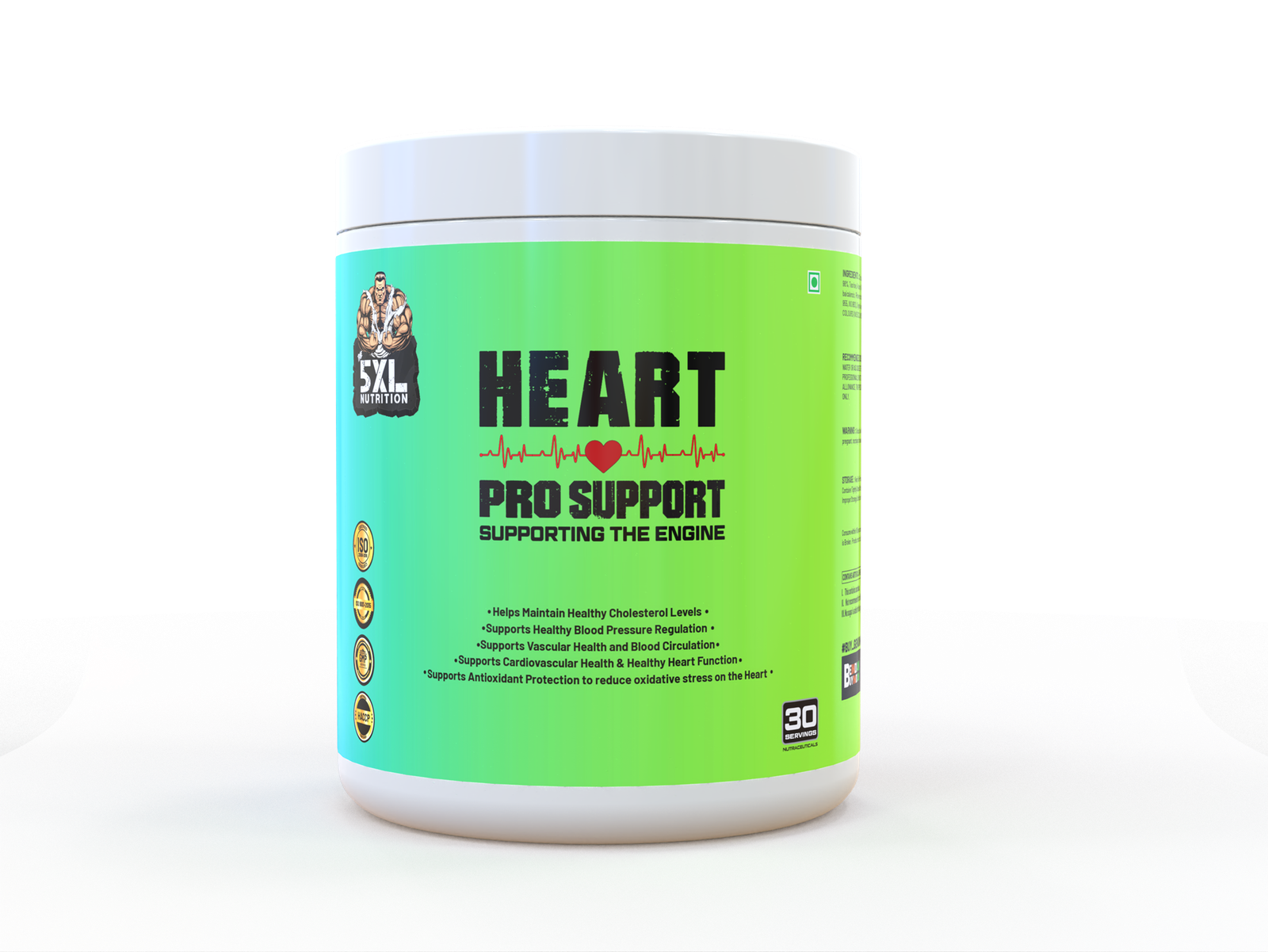
The 5XL built Heart Pro Support as a herbal and nutrient cardiovascular support formula around a specific, deliberately modest claim: supporting blood pressure and cholesterol levels that are already within a normal range, and supporting general circulation, framed explicitly as wellness support, not disease treatment.
This claim framing matters more than it might appear. Unfortunately, the heart health supplement category in India includes a meaningful number of products making implicit or explicit “prevents heart attack” or “reverses heart disease” claims, language that no over-the-counter supplement can legitimately support with evidence. Frankly, that’s dangerous when it leads someone to delay or substitute for appropriate medical care.
What “support” means in this formula’s context: 5XL designed Heart Pro Support as a proactive wellness addition for adults without diagnosed cardiovascular disease who want general nutritional support alongside the things that actually matter most for cardiovascular health – diet, exercise, sleep, stress management, and not smoking. It explicitly doesn’t position itself as a treatment for diagnosed hypertension, high cholesterol, or any cardiovascular condition, all of which require medical management.
Manufacturing and verification: The product carries GMP certification and FSSAI approval, with batch-level product authentication available at the5xlnutrition.com/verify-product, a meaningful differentiator in this comparison, since none of the other seven products reviewed offer equivalent batch verification.
Who it’s appropriate for: Adults without diagnosed cardiovascular disease seeking general proactive wellness support should consider this, ideally as one part of a broader lifestyle approach including regular exercise, a balanced diet, and routine health checkups – not as a substitute for any of those things, and not as an alternative to prescribed treatment for anyone with a diagnosed condition.
Shop 5XL Heart Pro Support at the5xlnutrition.com
How the Other Comparison Products Stack Up
HK Vitals Fish Oil
This budget-accessible Omega-3 fish oil option offers a standard formulation and FSSAI approval. However, sourcing transparency and third-party heavy metal testing aren’t prominently stated, a meaningful gap for a fish-derived product given the documented concern around heavy metal accumulation (mercury, in particular) in some fish oil sources. Overall, it’s reasonable for buyers who prioritise affordability over sourcing detail.
Best suited for: Budget Omega-3 buyers.
Neuherbs Omega-3
This deep-sea fish-sourced Omega-3 carries a stated purity focus, making it among the more transparency-forward Omega-3 options in this comparison on sourcing claims, though it doesn’t prominently display independent third-party testing documentation. It holds FSSAI approval and GMP certification.
Best suited for: Purity-focused Omega-3 buyers wanting deep-sea sourcing specifically.
Healthvit CoQ10
This straightforward CoQ10 supplement carries FSSAI approval and GMP certification. Some marketing language uses “may help” framing that, while not making outsized claims, reflects the general uncertainty appropriately associated with CoQ10’s evidence base outside the specific statin-depletion and heart-failure-adjunct contexts discussed above.
Best suited for: Statin users (under medical guidance) wanting a straightforward, accessible CoQ10 option.
GNC CoQ-10
This internationally recognised CoQ10 brand follows international GMP manufacturing standards. It operates under import licensing rather than domestic FSSAI manufacturing oversight, alongside the price premium typically associated with international brand imports in the Indian market.
Best suited for: Brand-trust buyers specifically wanting international CoQ10 sourcing.
Himalaya Heart Care
This long-established Ayurvedic herbal heart formula carries significant market history and brand trust among traditional medicine-preferring consumers in India. Some marketing language leans into traditional-medicine framing, which buyers should read in the same evidence-aware context as any supplement category claim, since traditional use history differs meaningfully from clinical trial evidence. Consumers should understand that distinction when evaluating any herbal cardiovascular product.
Best suited for: Buyers with a specific preference for traditional Ayurvedic herbal formulations.
Who Should Consider a Heart Health Supplement (and Who Shouldn’t)
Heart health supplements generally suit adults who want proactive nutritional support alongside a healthy lifestyle, not people treating a diagnosed cardiovascular condition. People on statin medication, those with documented nutrient deficiencies, or individuals over 40 wanting general cardiovascular wellness support may consider a supplement after speaking with a healthcare provider.
Reasonable candidates for considering a heart health supplement (with medical input):
Adults on statin medication, specifically regarding CoQ10, given the documented depletion mechanism discussed above; adults with documented low Omega-3 intake (limited fish consumption) seeking triglyceride support; generally healthy adults over 40 wanting proactive wellness support as one part of a broader lifestyle approach; and individuals already managing cardiovascular risk factors through diet, exercise, and medical care who want to discuss supplementation as a complementary addition with their doctor.
Who should not rely on a supplement as a primary intervention, and should prioritise medical care first:
Anyone with diagnosed heart disease, prior heart attack, or stroke; anyone on blood-thinning medication, since Omega-3 at high doses may increase bleeding risk and this combination specifically requires medical guidance; anyone with diagnosed hypertension not yet well-controlled by prescribed treatment; pregnant or breastfeeding women, without specific medical guidance; and anyone currently experiencing symptoms (chest pain, shortness of breath, irregular heartbeat), since these require immediate medical evaluation, not a supplement purchase.
Is It Safe to Take Omega-3 and CoQ10 Together?
Yes. People generally consider CoQ10 and Omega-3 safe to take together, since they work through different, complementary mechanisms: CoQ10 supports cellular energy production in heart cells, while Omega-3 primarily affects triglycerides and inflammation. In fact, taking Omega-3 alongside CoQ10 may even improve CoQ10 absorption, since both are fat-soluble. That said, people taking blood-thinning medication should consult their doctor before adding Omega-3, as high doses may increase bleeding risk.
Heart Disease Risk in India: Why This Matters More Here
Cardiovascular disease remains the leading cause of death in India, and several India-specific epidemiological patterns make this a particularly relevant topic for Indian readers specifically, beyond global averages.
Earlier onset: Indians, on average, develop coronary artery disease approximately 5-10 years earlier than Western populations, with a meaningfully higher proportion of cardiac events occurring in adults under 50. Researchers attribute this pattern to a combination of genetic predisposition (including a higher prevalence of certain lipid abnormalities), dietary patterns, and rising rates of diabetes and metabolic syndrome.
Higher relative risk at lower BMI: Research has documented that Indians and South Asians more broadly tend to develop cardiovascular risk factors (insulin resistance, abnormal lipid profiles) at lower body mass index thresholds than Western population reference ranges suggest. As a result, standard BMI-based risk categorisation can underestimate cardiovascular risk in Indian individuals who don’t appear overweight by conventional standards.
Rising urban risk factors: Increasing rates of sedentary urban lifestyles, dietary shifts toward processed foods, and high background rates of diabetes (India has one of the largest diabetic populations globally) compound cardiovascular risk across the population.
What this means practically: Given this risk profile, routine cardiovascular health checkups (blood pressure, lipid panel, blood sugar) from a younger age than might seem necessary, alongside genuine lifestyle fundamentals – diet, regular exercise, stress management, not smoking, adequate sleep – matter more for Indian adults than any supplement on this comparison list. At their most legitimate and well-evidenced, supplements complement this foundation; they never substitute for it.
FAQs
Q: What is the best heart health supplement?
No single “best” heart health supplement suits everyone; the right choice depends on individual risk factors, and you should ideally discuss it with a doctor. The most researched options are Omega-3 fish oil (supports triglyceride levels and reduces inflammation) and CoQ10 (supports cellular energy in heart muscle, particularly relevant for people on statin medication). Herbal cardiovascular support formulas, like 5XL Heart Pro Support, work as a proactive wellness addition alongside diet and exercise, not as a replacement for prescribed treatment. No over-the-counter supplement has proven it can prevent heart attacks or strokes.
Q: What is the best supplement for heart health and blood pressure?
Researchers most commonly associate magnesium, CoQ10, and Omega-3 fatty acids with blood pressure support. A 2007 meta-analysis of 12 trials found that CoQ10 supplementation correlated with an average reduction of 11 mmHg systolic and 7 mmHg diastolic blood pressure, though results vary by individual. These nutrients work through different mechanisms and may complement each other. Anyone with diagnosed hypertension should manage it under medical supervision; supplements are a possible addition to, not a substitute for, prescribed treatment.
Q: Do heart health supplements actually work?
The evidence varies significantly by ingredient. CoQ10 has reasonably strong evidence for supporting people on statin medication and for certain heart failure outcomes, per research published in JACC: Heart Failure. Omega-3 fish oil’s evidence for general heart attack or stroke prevention from over-the-counter doses runs weaker than commonly marketed; Johns Hopkins Medicine notes no substantial proof exists for these specific claims at typical supplement doses. Herbal cardiovascular formulas function as general wellness support rather than clinically validated treatments. Overall, supplements work best as part of a broader lifestyle approach, not as a standalone solution.
Q: Is it safe to take Omega-3 and CoQ10 together?
Yes. People generally consider CoQ10 and Omega-3 safe to take together, since they work through different, complementary mechanisms. Taking Omega-3 alongside CoQ10 may even improve CoQ10 absorption, since both are fat-soluble. People taking blood-thinning medication should still consult their doctor before adding Omega-3, as high doses may increase bleeding risk.
Q: Who should consider a heart health supplement?
Heart health supplements generally suit adults who want proactive nutritional support alongside a healthy lifestyle, not people treating a diagnosed cardiovascular condition. People on statin medication, those with documented nutrient deficiencies, or individuals over 40 wanting general cardiovascular wellness support may consider a supplement after speaking with a healthcare provider. Anyone with diagnosed heart disease, on blood thinners or blood pressure medication, who is pregnant or nursing should consult a doctor before starting any heart-related supplement.
Q: Can a supplement lower my cholesterol instead of taking a statin?
No, nobody should use a supplement as a substitute for prescribed statin medication without explicit medical guidance. Statins carry a robust, extensively studied evidence base for reducing cardiovascular events in appropriate patients. Supplements like Omega-3 (for triglycerides specifically, a different lipid marker from LDL cholesterol) may offer complementary support, but they aren’t a validated replacement for statin therapy in individuals who have been prescribed it. Discuss any changes to cholesterol management with your prescribing doctor.
Q: Why do some heart supplements make stronger claims than others?
Regulatory enforcement of supplement marketing claims varies, and the Indian supplement market includes products with claim language ranging from appropriately conservative (“supports normal-range levels”) to concerning overreach (“prevents heart disease,” “reverses arterial blockage”). You should treat the latter category of claims as a red flag regardless of brand reputation, since no over-the-counter supplement has clinical trial evidence supporting disease prevention or reversal claims of this nature.
A Note on Supplements and Medical Care
Nothing in this article constitutes medical advice, and nothing in this product category – regardless of brand, certification, or marketing claim – should substitute for medical diagnosis, prescribed treatment, or professional cardiovascular care. Heart disease is serious, often silent in its early stages, and doctors manage it best through routine checkups, appropriate medical treatment when indicated, and the lifestyle fundamentals (diet, exercise, sleep, stress management, not smoking) that carry the strongest evidence base of anything discussed in this comparison.
If you experience any symptoms suggestive of a cardiovascular event – chest pain, pressure, shortness of breath, pain radiating to the arm or jaw, sudden severe headache, or irregular heartbeat – seek immediate medical attention. Do not wait, and do not attempt to address these symptoms with any supplement.
For general wellness support alongside appropriate medical care and a healthy lifestyle, the products compared in this article represent reasonable options within their respective categories, chosen and used with realistic expectations about what they can and cannot do.