Best EAA Supplement for Muscle Recovery in India: What 7g EAAs + Electrolytes Actually Do After Training
The 45 Minutes That Decide How You Feel Tomorrow
Training ends. You rack the weights, towel off, check your phone. What happens in the next 45 minutes biologically, inside your muscle tissue determines a meaningful portion of how sore you’ll be tomorrow. how quickly your next session can happen, and whether this week’s training translates into next month’s progress.
Most Indian athletes know the broad strokes: eat protein, rehydrate, sleep well. Far fewer understand the specific biochemical sequence happening in muscle tissue during this window.why a 7g essential amino acid (EAA) supplement combined with electrolytes is positioned precisely to intervene in that sequence in ways that a protein shake alone, taken an hour later, cannot replicate.
This article breaks down exactly what happens to muscle tissue during and after training, why amino acid availability in that specific window matters, why electrolytes are not a separate concern from amino acid recovery but a mechanistically linked one, and what a properly dosed EAA + electrolyte formula does that other recovery approaches miss.
What Actually Happens to Your Muscles During Training
Muscle Protein Breakdown Doesn’t Wait for You to Finish
During resistance training – particularly eccentric loading (the lowering phase of a squat, the negative of a curl) – muscle fibres experience microscopic structural damage. Z-disc streaming, sarcomere disruption, and microtears in the connective tissue surrounding muscle fibres all occur during the session itself, not afterward.
Simultaneously, muscle protein breakdown (MPB) increases during exercise – driven by both the mechanical damage and the metabolic stress of sustained contraction. This is a normal and necessary part of the adaptation process: damaged proteins must be cleared before new, stronger protein structures can be built in their place.
The problem is that muscle protein synthesis (MPS) – the rebuilding process – does not automatically outpace breakdown. Whether your net protein balance after training is positive (anabolic, muscle-building) or negative (catabolic, net muscle loss) depends almost entirely on amino acid availability in the bloodstream during and immediately after the session.
The Post-Exercise Window: Why Timing Isn’t Just Marketing
For roughly 45-90 minutes following intense training, skeletal muscle exhibits heightened sensitivity to amino acids – a phenomenon often called the “anabolic window.” During this period:
- Blood flow to trained muscle remains elevated, improving nutrient delivery
- Amino acid transporter proteins (particularly for leucine and other EAAs) are upregulated at the muscle cell membrane
- mTORC1 signalling – the primary regulator of muscle protein synthesis – remains primed from the mechanical stimulus of training
- Insulin sensitivity in trained muscle is temporarily increased, improving glucose and amino acid uptake together
The scientific consensus has refined over the years – the “window” is real but more forgiving than early 2000s marketing suggested, particularly for athletes who ate a protein-containing meal 2-3 hours before training. However, for athletes training fasted, training in the evening after a long gap since their last meal, or undertaking high-volume sessions with significant muscle damage, amino acid availability in this window has a measurable effect on net protein balance and next-day recovery markers.
What Happens If Amino Acids Aren’t Available
If circulating amino acid levels are low when this window opens – common after fasted training, after long sessions that deplete circulating amino acids, or simply because the post-workout meal is 60–90 minutes away – the body has two options: continue net protein breakdown until dietary amino acids arrive, or source amino acids from existing muscle tissue to support the repair processes already underway.
Neither outcome is catastrophic in isolation. But repeated, session after session, across months of training, the cumulative effect is a smaller net anabolic signal per training session – translating to slower strength gains, more pronounced and longer-lasting soreness, and a recovery deficit that compounds across a training week.
Why EAAs Specifically – Not Just “Protein” – Matter in This Window
The Completeness Requirement
Muscle protein synthesis is not initiated by a single amino acid arriving in the bloodstream – it requires all 9 essential amino acids (leucine, isoleucine, valine, lysine, methionine, phenylalanine, threonine, tryptophan, histidine) to be present simultaneously for the synthesis process to proceed to completion. Leucine triggers the mTORC1 signalling cascade that initiates synthesis; the remaining 8 EAAs are the structural substrate that gets incorporated into new muscle protein.
A whole-food meal or whey protein shake provides all 9 EAAs – but digestion takes time. Whole protein requires gastric breakdown, pancreatic enzyme digestion, and intestinal absorption before amino acids reach circulation – a process that takes 60-120 minutes depending on meal composition.
Free-form EAAs require no digestion. They are already in their absorbable form and reach circulation within 15-30 minutes of ingestion. For the 45-90 minute post-exercise window, this speed difference is the entire point. An EAA supplement consumed immediately post-workout – or sipped intra-workout – delivers the complete amino acid profile to muscle tissue while the anabolic window is open, rather than after it has begun to close.
Why 7g Is the Functional Threshold
Research establishing muscle protein synthesis response to EAA dosing has consistently identified approximately 7-10g of EAAs (containing 2-3g of leucine) as the dose that maximises the MPS response in a single serving. Doses below this threshold produce a measurably smaller synthesis response; doses significantly above this threshold do not produce a proportionally larger response – the MPS response to a single bolus of amino acids is not linear indefinitely; it saturates.
This means 7g EAAs is not an arbitrary marketing number – it reflects the dose at which the anabolic signalling response is maximised without unnecessary excess. A product providing 5g EAAs (like several BCAA-heavy or “amino energy” formulas) sits below this threshold; a product providing 15-20g provides amino acids beyond the point of additional MPS benefit, at additional cost, for the same recovery outcome.
Anti-Catabolism: The Underappreciated Half of Recovery
Most discussion of post-workout nutrition focuses on muscle protein synthesis – the “building” side. The “breakdown” side receives less attention but is equally important to net recovery outcome.
Circulating EAAs – particularly leucine – directly suppress muscle protein breakdown through inhibition of the ubiquitin-proteasome pathway, one of the primary cellular mechanisms for protein degradation. This means EAA supplementation in the post-exercise window doesn’t only stimulate new protein synthesis – it simultaneously reduces the rate at which existing muscle protein (including the damaged fibres from training) is broken down for energy or amino acid recycling.
The combined effect – increased synthesis, decreased breakdown – is what produces the shift from a negative to positive net protein balance that defines effective post-workout recovery nutrition.
Electrolytes in Recovery: Not Just About Thirst
The inclusion of electrolytes (sodium, potassium, magnesium) in an EAA formula is frequently dismissed as a hydration afterthought. This significantly understates their role – electrolytes are mechanistically connected to amino acid recovery in ways that make their inclusion functionally important, not just convenient.
Sodium-Dependent Amino Acid Transport
Amino acid uptake into muscle cells occurs via specific transporter proteins – many of which are sodium-dependent co-transporters. The System A and System N amino acid transporters, responsible for moving several EAAs across the cell membrane into muscle tissue, require a sodium gradient to function. When sodium status is depleted – as it is significantly during training in Indian heat and humidity – the efficiency of amino acid transport into muscle cells is reduced, regardless of how many amino acids are circulating in the bloodstream.
This means: an EAA supplement without adequate sodium may deliver amino acids to the bloodstream less effectively to the muscle cells that need them. The electrolyte inclusion in a recovery-focused EAA formula is not a separate hydration feature bolted onto an amino acid product – it is a functional component of the amino acid delivery mechanism itself.
Magnesium and Muscle Relaxation Post-Training
Muscle contraction is calcium-driven; muscle relaxation requires calcium to be actively pumped back out of the muscle cell – a magnesium-and-ATP-dependent process. Magnesium depletion during training (lost in sweat at meaningful rates in Indian conditions) impairs this calcium clearance, contributing to the sensation of persistent muscle tension, tightness, and cramping that some athletes experience in the hours after intense training.
Replenishing magnesium in the post-workout window supports the muscle relaxation process that begins as soon as training ends – directly relevant to how “recovered” muscle feels in the hours following a session.
Potassium and Neuromuscular Function
Potassium is the primary intracellular cation and is critical for the membrane potential that governs muscle fibre excitability and contraction. Significant potassium losses during prolonged or intense training in heat can contribute to neuromuscular fatigue that persists beyond the training session itself – affecting how “heavy” the next day’s session feels even when muscle soreness itself is not the limiting factor.
The India-Specific Electrolyte Case
Indian athletes training in ambient temperatures of 30-40°C for 60-90 minutes can lose 1.5-2.5 litres of sweat per session – carrying with it sodium (the most abundant electrolyte lost), potassium, and magnesium at rates significantly higher than athletes training in temperate climates. An EAA formula designed without electrolyte consideration may be addressing the amino acid side of recovery while leaving the electrolyte-dependent transport and neuromuscular mechanisms under-supported – particularly relevant for the 8 months of the year when Indian training conditions are hot.
The Complete Post-Workout Recovery Sequence
Understanding where EAAs + electrolytes fit requires seeing the full sequence of post-workout recovery nutrition:
0-15 minutes post-workout (or sipped intra-workout): EAA + electrolyte formula (7g EAAs). Rapid amino acid delivery to circulation while the anabolic window is maximally open; electrolyte replenishment supports amino acid transport and neuromuscular recovery from the first minutes after training ends.
15-60 minutes post-workout: Whole food meal or whey protein shake with carbohydrates. By this point, the EAA dose has already begun supporting MPS and suppressing MPB. The whole food/whey meal extends amino acid availability over a longer digestion curve and provides the caloric and carbohydrate replenishment (glycogen resynthesis) that pure amino acids do not address.
60+ minutes post-workout: Continued normal eating pattern through the day, maintaining total daily protein target (1.6-2.2g/kg bodyweight for most training goals).
This is not a “replace your protein shake with EAAs” message. It is a “close the gap between the end of training and your next meal” message – a gap that, for many Indian athletes juggling commute times, work schedules, and meal prep logistics, is frequently 45-90 minutes or longer.
Why This Matters More for Indian Training Patterns
The Commute Gap
A significant proportion of Indian gym-goers train before or after work/college, often in facilities without easy access to a full post-workout meal. The gap between finishing a session and consuming a complete meal frequently extends to 60-90 minutes due to commute time, shower, and meal preparation. An EAA + electrolyte serving taken immediately post-workout – easily carried and consumed in a gym bag – closes this gap with negligible logistical burden.
Fasted Morning Training
Athletes training at 6 AM before breakfast are training with minimal circulating amino acids from the outset. As covered in the EAA vs BCAA comparison, EAAs taken before or during fasted training address the catabolism risk at its highest point. The recovery benefit of EAAs extends naturally from pre-training use through the post-training window – a single serving sipped across the session and immediately after provides continuous amino acid availability through the entire training and immediate post-training period.
Heat-Driven Electrolyte Depletion
As discussed above, India’s climate produces electrolyte losses that meaningfully exceed those in temperate-climate training. An EAA formula without electrolytes leaves this dimension of recovery unaddressed – requiring a separate electrolyte product (ORS, coconut water, electrolyte tablets) to be added to the recovery stack. A combined formula consolidates this into a single post-workout serving.
Vegetarian Protein Digestion Timing
As covered in the gut health and protein absorption article in this series, whole-food plant proteins (dal, paneer, legumes) require longer digestive processing than animal proteins or whey – meaning the amino acid delivery timeline from a vegetarian post-workout meal is slower than for an omnivore consuming the same meal timing. For vegetarian Indian athletes, the gap between training end and amino acid availability from food is structurally longer – making the immediate-availability profile of free-form EAAs particularly valuable.
EAA + Electrolytes vs. Other Post-Workout Recovery Approaches
| Approach | Amino Acid Delivery Speed | Electrolyte Support | Anabolic Window Coverage | Practical for Gym Bag |
| 7g EAA + Electrolytes | 15-30 min (free-form) | Integrated | Immediate | Powder, mix with water |
| Whey protein shake alone | 30-60 min (requires digestion) | None | Delayed | Yes |
| BCAA + separate electrolyte tablet | 15-30 min for BCAAs (partial profile) | If added | Partial (3/9 EAAs) | Two products |
| Whole food meal | 60-120 min | Variable | Outside window for most | Requires time/access |
| Nothing until next meal | 60-120+ min | None | Window closes unaddressed | N/A |
The 5XL Nutrition EAA: 7g EAAs + Electrolytes, Built for Indian Recovery
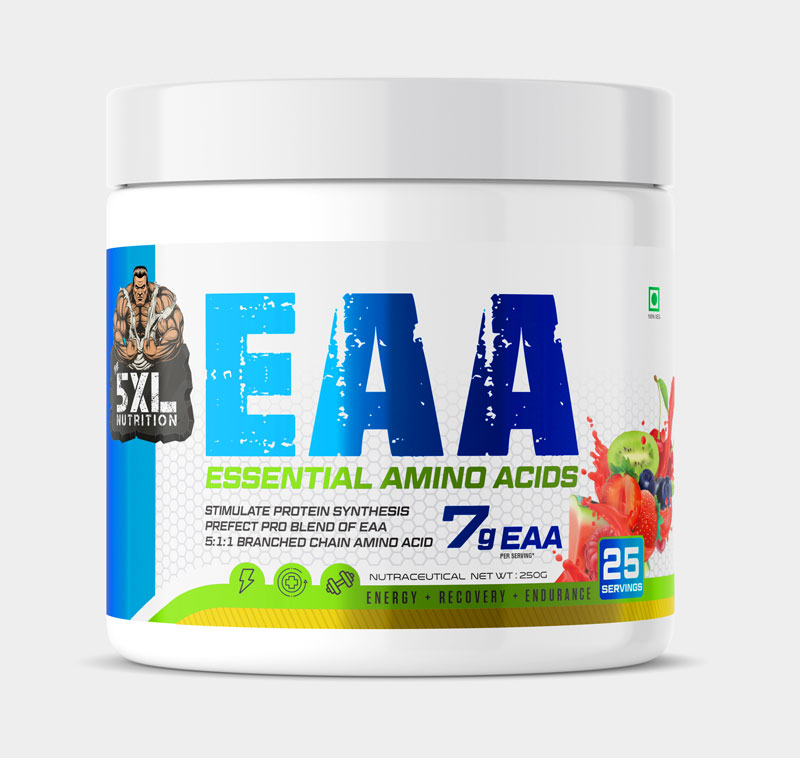
The 5XL Nutrition EAA delivers 7g of all 9 essential amino acids per serving – the dose at which clinical research demonstrates maximal muscle protein synthesis response – combined with an integrated electrolyte matrix of sodium, potassium, and magnesium.
The amino acid profile: Every one of the 9 EAAs is included at a disclosed individual dose – including the 2-3g leucine threshold for mTORC1 activation, alongside lysine, methionine, and the remaining EAAs that complete the synthesis substrate. No proprietary blending obscures the actual composition.
The electrolyte rationale: Sodium supports the sodium-dependent amino acid transporters that move EAAs from circulation into muscle tissue – making the electrolyte inclusion functionally connected to amino acid delivery, not a separate hydration add-on. Magnesium supports post-training muscle relaxation; potassium supports neuromuscular recovery – both relevant to the “how do my muscles feel tomorrow” outcome that defines subjective recovery quality.
Zero added sugar. The formula does not rely on a glycogen-replenishment carbohydrate load – it is designed as a targeted amino acid and electrolyte delivery vehicle, intended to be paired with your post-workout meal’s carbohydrate content rather than substituting for it.
Format and practicality: A single scoop in 400-500ml water, consumed intra-workout (sipped throughout) or immediately post-workout. Vegan certified, FSSAI approved, GMP + ISO certified manufacturing, and batch-level authentication at the5xlnutrition.com/verify-product
Recommended recovery protocol:
- Intra-workout (primary recommendation): 1 scoop dissolved in water, sipped throughout the session – covers both intra-workout catabolism prevention and immediate post-workout recovery initiation
- Immediately post-workout (alternative): 1 scoop within 15 minutes of finishing training, followed by your normal post-workout meal 45-60 minutes later
- Fasted training: 1 scoop 10-15 minutes pre-session, continuing to provide recovery support through and after the session
Shop 5XL Nutrition EAA Use code GOF35 for 35% off on MRP
Common Mistakes in Post-Workout EAA Use
Mistake 1:
Taking EAAs and then skipping the post-workout meal entirely EAAs at 7g provide approximately 28g of amino acids by weight but minimal total calories (28-40 kcal) and no significant carbohydrate for glycogen replenishment. They initiate and support the recovery process – they do not replace the caloric and nutrient completeness of a proper post-workout meal. Athletes using EAAs as a meal substitute are under-fuelling recovery, not optimising it.
Mistake 2:
Inconsistent timing The recovery benefit of EAAs is tied to the post-exercise window – taking them 3 hours after training, disconnected from any training session, provides amino acids but misses the mechanistic timing advantage that makes EAA supplementation specifically valuable in this context. Consistency of timing (intra- or immediately post-workout) is what produces the cumulative recovery benefit across a training block.
Mistake 3:
Believing more is better As covered above, the MPS response to EAA dosing saturates around 7-10g. Doubling the dose to 14-20g does not double the recovery benefit – it simply provides amino acids beyond the point of additional synthesis response, at proportionally higher cost. 7g is the evidence-based target, not a starting point to be exceeded.
Mistake 4:
Ignoring the electrolyte component when training in heat Athletes who strip electrolytes from their recovery stack – opting for a “pure amino acid” product without electrolytes – are leaving the sodium-dependent transport mechanism and neuromuscular recovery dimensions of post-workout recovery unaddressed, particularly during Indian summer training. The electrolyte inclusion is not redundant with a separate hydration strategy; it is integrated into the same delivery window as the amino acids.
FAQ
Q: Will 7g of EAAs actually make a noticeable difference to my recovery?
The 7g dose is calibrated to the threshold at which muscle protein synthesis response is maximised in research – meaning it is neither under-dosed nor wastefully over-dosed. Subjectively, athletes most likely to notice a difference are those training fasted, those with significant gaps (45+ minutes) between training and their next meal, and those training at high volume where cumulative muscle damage is greater. Athletes already eating a substantial protein-containing meal within 30 minutes of training may notice a smaller incremental difference – though the anti-catabolic effect during the session itself remains relevant regardless of post-workout meal timing.
Q: Can EAAs reduce muscle soreness (DOMS)?
There is reasonable evidence that EAA supplementation around training reduces markers of muscle damage (serum creatine kinase) and may modestly reduce the severity and duration of DOMS – primarily through the anti-catabolic mechanism reducing the extent of protein breakdown during and after training. EAAs are not a direct anti-inflammatory or pain-relief intervention; the soreness reduction, where observed, is a downstream effect of reduced net muscle protein breakdown.
Q: Do I need EAAs if I already drink a protein shake right after training?
If “right after training” means within 10-15 minutes and the shake is whey-based (fast-digesting), the incremental benefit of also taking EAAs is smaller – whey already provides a complete EAA profile that begins digesting quickly. The EAA advantage is most relevant for the gap period – if your shake is 45-60+ minutes after training due to commute or logistics, or if you train fasted, EAAs address that gap specifically.
Q: Is the electrolyte content in 5XL EAA enough to replace a separate electrolyte drink?
For a single training session of up to 60-75 minutes in moderate conditions, the integrated electrolyte content addresses the amino-acid-transport and neuromuscular recovery dimensions discussed in this article. For very long sessions (90+ minutes) in extreme heat with substantial sweat loss, additional electrolyte intake (ORS, coconut water) alongside your EAA serving may be appropriate – the EAA formula’s electrolytes are calibrated for amino acid delivery support, not as a standalone rehydration protocol for extreme conditions.
Q: Should I take EAAs on rest days for recovery?
Rest-day EAA use is optional rather than essential for most athletes meeting daily protein targets from food. However, athletes in higher training volumes, those managing accumulated fatigue across a training block, or vegetarian athletes with less consistent amino acid completeness across meals may benefit from continued EAA use on rest days as part of an ongoing recovery support strategy – though the acute post-exercise timing advantage discussed in this article is specific to training days.
Q: How does this differ from taking creatine for recovery?
Creatine and EAAs support recovery through entirely different mechanisms and are complementary, not competing. Creatine expands the phosphocreatine energy system, improving training capacity and supporting cellular hydration – its recovery benefit is primarily about enabling more productive training sessions and supporting the cellular environment for growth. EAAs directly provide the amino acid substrate and anti-catabolic signalling for muscle protein synthesis in the post-exercise window. Many athletes use both: EAAs intra/post-workout, creatine with the post-workout meal.
The Bottom Line
The 45-90 minutes after training is not a passive recovery period – it is an active biochemical negotiation between muscle protein synthesis and muscle protein breakdown, with the outcome determined largely by amino acid and electrolyte availability during that window.
A 7g EAA + electrolyte formula is positioned precisely at this intersection: free-form amino acids that bypass digestion to reach circulation within 15-30 minutes, at the dose threshold that maximises the synthesis response, combined with the sodium, potassium, and magnesium that support both amino acid transport into muscle cells and the neuromuscular recovery process – all of which is meaningfully more taxed in Indian training conditions than in temperate climates.
This is not a replacement for your post-workout meal, your daily protein target, or your hydration strategy. It is the bridge that closes the gap – the gap created by commute times, fasted training, vegetarian digestion timelines, and Indian heat – between the moment training ends and the moment your body actually has what it needs to begin recovering.
Shop 5XL Nutrition EAA Use code KSY35 at checkout for 35% off on MRP