Marine Collagen vs Bovine Collagen vs Plant Collagen: Which Is Best for Indian Skin, Hair & Joints?
The Collagen Confusion Every Indian Buyer Faces
You decide to try collagen. You open any major Indian e-commerce platform and immediately face a wall of options – marine collagen, bovine collagen, plant collagen builder, Type I, Type II, Type III, UC-II, hydrolyzed peptides, and half a dozen more terms that the product pages use interchangeably.
This confusion is not accidental. It is the predictable result of a supplement category that has grown faster than the consumer education around it.
The honest answer to “which collagen is best?” is not one product. It is one framework – matching the collagen type and source to the biological goal. Skin and hair require a different collagen type than joints. Joints require a different mechanism than tendons. Vegans need a completely different approach than omnivores.
This article provides that framework: the science of what each collagen type actually does, how bioavailability differs by source, what Indian dietary and skin conditions make relevant, and which product is correct for which goal – without the marketing language that has made this category harder to navigate than it should be.
Collagen Basics: The Types That Matter for Indian Consumers
The human body contains at least 28 distinct types of collagen, each with a different molecular structure and tissue distribution. For supplement purposes, four types are relevant to the Indian consumer:
Type I Collagen – Skin, Hair, Nails, Tendons, Bone
Type I is the most abundant collagen in the human body – comprising over 90% of total body collagen. It forms dense, parallel fibrils that provide the tensile strength and structural integrity of skin, hair follicles, nail beds, tendons, ligaments, and bone matrix.
In skin specifically, Type I collagen forms the scaffolding of the dermis – the layer responsible for firmness, resistance to wrinkling, and wound healing speed. Its decline with age (beginning in the mid-twenties at approximately 1-1.5% per year) is the primary collagen-related driver of visible skin ageing: fine lines, loss of firmness, and slower recovery from UV damage.
Sources: Marine collagen (fish skin, scales) is predominantly Type I. Bovine collagen (cow hide) provides Type I alongside Type III. Chicken skin provides Type I.
Type II Collagen – Joint Cartilage
Type II is the primary collagen of articular cartilage – the smooth tissue covering bone surfaces at joints. It forms a looser, mesh-like fibrillar network that allows cartilage to absorb compressive loads from movement and exercise.
Type II collagen degradation – from exercise, ageing, or inflammatory processes – is a primary mechanism of joint discomfort, reduced mobility, and osteoarthritis progression. Unlike Type I, Type II collagen supplementation for joint benefits works best in its undenatured form (UC-II) through an immunological mechanism, not as hydrolyzed peptides.
Sources: Bovine cartilage, chicken sternum (the source of UC-II). Not present in meaningful quantities in marine collagen.
Type III Collagen – Skin Elasticity and Vascular Structure
Type III is the second-most abundant collagen in skin, forming a more elastic, looser fibrillar network alongside Type I’s denser structure. It is particularly concentrated in:
- Young, elastic dermis (its proportion relative to Type I decreases with age – contributing to skin stiffening)
- Arterial walls and blood vessel structure
- Early-stage wound healing and tissue repair
The loss of Type III relative to Type I with age is one reason older skin feels less supple even when structural density is maintained. A collagen supplement providing both Type I and Type III addresses both structural density and elastic resilience.
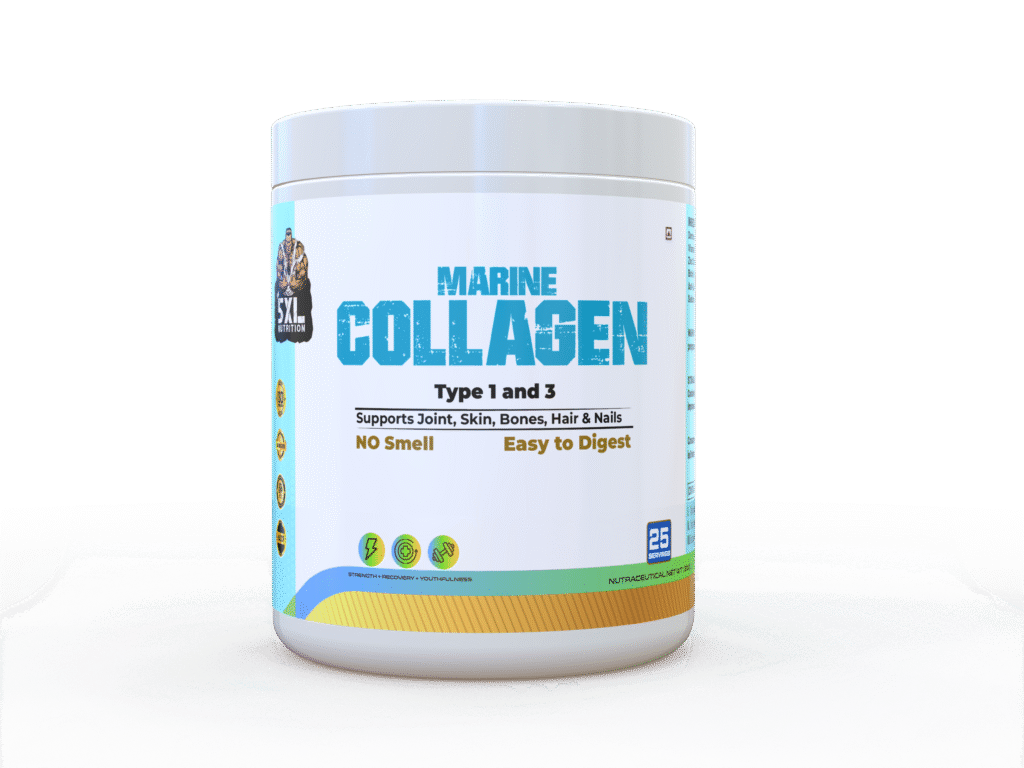
Sources: Bovine collagen provides Type III alongside Type I. Some marine collagen products provide both – The 5XL Nutrition Marine Collagen is the only Indian marine collagen in the comparison providing both Type I and Type III in its standard formula.
UC-II (Undenatured Type II) – Joint Immune Mechanism
UC-II is not simply “Type II collagen” – it is Type II collagen in its intact, undenatured form, sourced from chicken sternum and standardised to 40mg. Its mechanism is immunological (oral tolerisation via Peyer’s patches) rather than substrate-based, making it categorically different from all hydrolyzed collagen products regardless of type.
Marine Collagen: The Skin and Hair Specialist
Source: Fish skin, scales, and bones – typically from deep-sea fish (cod, tilapia, snapper) or freshwater species. Collagen types provided: Primarily Type I; some formulas (including 5XL) include Type III. Form: Almost always hydrolyzed into peptides (collagen hydrolysate) for supplementation.
Why Marine Collagen Has the Highest Bioavailability
The molecular weight of hydrolyzed marine collagen peptides is approximately 300-800 Daltons – significantly smaller than bovine collagen peptides (1,000-3,000 Daltons for equivalent processing). Smaller molecular size means:
- Faster absorption across the intestinal epithelium
- Higher peak plasma amino acid concentrations after ingestion
- More efficient delivery to dermal fibroblasts, the cells that produce new collagen in skin
Research quantifies this advantage: marine collagen is approximately 1.5× more bioavailable than bovine collagen on a per-gram basis for the same hydrolyzation level. For skin-focused supplementation where fibroblast delivery is the primary goal, this bioavailability advantage is clinically meaningful.
Marine Collagen and Indian Skin: The UV Damage Context
Indian skin – across all Fitzpatrick types – is exposed to among the highest UV irradiance levels globally, particularly in summer (April-September). UV radiation triggers matrix metalloproteinases (MMPs) in the dermis that cleave Type I collagen fibres – the primary enzymatic mechanism of UV-induced skin ageing. UVA penetrates to the dermis regardless of melanin concentration, making collagen degradation a pan-Indian concern across all skin tones.
Marine collagen peptides – when absorbed – stimulate fibroblasts to increase Type I collagen synthesis and simultaneously inhibit MMP activity. The net result is both increased collagen production and reduced degradation – a dual mechanism that is particularly relevant in the Indian UV environment.
Who Should Choose Marine Collagen
- Anyone with skin, hair, nail, or anti-ageing as their primary goal
- Athletes wanting tendon and connective tissue repair support
- Vegetarian or health-conscious consumers comfortable with fish-derived ingredients
- Those seeking the highest bioavailability collagen for skin delivery
- Anyone prioritising a complete formula with co-factors (Vitamin C, hyaluronic acid, biotin)
What marine collagen does not address: Joint cartilage (Type II), immune-mediated joint inflammation (requires UC-II), or gut collagen (different collagen architecture).
Bovine Collagen: The Versatile Broad-Spectrum Option
Source: Cow hide (most common), bone broth, or bovine cartilage (for Type II). Collagen types provided: Hide-derived = Type I + Type III. Cartilage-derived = Type II. Form: Hydrolyzed peptides for Types I and III; undenatured for Type II joint applications.
Type I + III: Where Bovine Matches Marine (and Where It Doesn’t)
Bovine hide collagen naturally provides both Type I and Type III – the combination relevant for both structural skin density and elastic resilience. This is a genuine advantage over marine-only products that provide exclusively Type I.
However, this advantage is largely offset by:
Lower bioavailability: Bovine peptides are larger molecules than marine peptides at equivalent hydrolyzation, producing lower peak plasma amino acid levels and slower fibroblast delivery.
Source and supply chain concerns: Bovine collagen quality depends heavily on the source animal’s diet and country of origin. Grass-fed, pasture-raised bovine collagen is generally preferred for quality and sustainability reasons – but this specification is rarely guaranteed or verifiable in the Indian market at accessible price points.
Religious and cultural context: Bovine collagen is derived from cows – an animal of significant religious and cultural sensitivity for the majority of India’s Hindu population. This is not a nutritional consideration but a deeply meaningful consumer consideration that drives a significant portion of Indian collagen buyers toward marine or plant alternatives.
Bovine Cartilage and Type II: The Joint Supplement Consideration
Bovine cartilage is a source of Type II collagen and glucosamine – both relevant for joint health. However, for the specific joint benefits achieved through oral tolerisation, chicken sternum-derived UC-II (undenatured Type II) has the most specific and well-replicated clinical evidence base. Bovine-derived collagen supplements marketed for joints primarily work through peptide substrate provision rather than immune re-education – a different and less targeted mechanism for cartilage-specific outcomes.
Who Should Choose Bovine Collagen
- Athletes wanting both Type I and Type III without a marine product preference
- Those building bone broth-based dietary protocols
- Individuals outside the Hindu community without religious sensitivity to bovine-derived products
- Cost-conscious buyers for whom bioavailability difference vs marine is an acceptable trade-off
What bovine collagen (hide-derived) does not address: The specific joint cartilage immunological mechanism (requires UC-II), and the peak bioavailability of marine peptides for skin delivery.
Plant Collagen Builder: What It Is, What It Isn’t, and Who It’s For
Source: No animal ingredients. Typically: Vitamin C (often from acerola cherry or amla), silica (from bamboo), antioxidants (grape seed, green tea), biotin, zinc, and various botanical extracts. Collagen types provided: None. Zero collagen. Form: Capsules or powder providing collagen synthesis co-factors and precursors.
The Critical Distinction: Collagen Synthesis Support ≠ Collagen Supplementation
Plant collagen builders do not contain collagen. They provide ingredients that support the body’s endogenous collagen production – by supplying the co-factors (Vitamin C, zinc, silica) and antioxidants that protect existing collagen from degradation.
This mechanism is real and has clinical support:
- Vitamin C is a required co-factor for prolyl hydroxylase and lysyl hydroxylase – the enzymes that stabilise the collagen triple helix. Without adequate Vitamin C, collagen synthesis is impaired regardless of amino acid availability.
- Silica (from bamboo or horsetail) has evidence for stimulating fibroblast collagen production and improving nail hardness in deficient individuals.
- Antioxidants (Vitamin E, grape seed extract, lycopene) reduce MMP-driven collagen degradation by neutralising the reactive oxygen species that activate MMPs.
The limitation: Plant builders can optimise the body’s existing collagen production capacity – but they cannot replace the direct substrate provision of hydrolyzed collagen peptides. An individual consuming plant builders still relies entirely on endogenous collagen synthesis, which declines with age, UV exposure, and dietary insufficiency. Direct collagen peptide supplementation adds exogenous substrate that plant builders cannot replicate.
India-Specific Consideration: Amla as a Natural Collagen Synthesis Support
Indian consumers have access to one of the most potent natural collagen synthesis supports in the world: amla (Indian gooseberry). Amla contains 20× more Vitamin C than oranges by weight and has been shown to specifically inhibit MMP activity, making it a genuine food-based collagen protection strategy. A daily amla (fresh, dried, or as amla powder in water) provides meaningful Vitamin C-driven collagen synthesis support regardless of which collagen supplement is chosen.
This doesn’t make plant collagen builders unnecessary – it means Indian consumers can partly replicate their mechanism through culturally familiar whole foods, while the plant builder format delivers a more concentrated, convenient, and consistently dosed version of the same approach.
Who Should Choose Plant Collagen Builder
- Vegetarians and vegans who cannot or will not consume fish or bovine-derived products
- Individuals with fish allergies
- Those whose primary goal is optimising existing collagen rather than directly supplementing declining levels
- Buyers wanting to complement a marine or bovine collagen supplement with additional co-factor support
What plant collagen builders cannot do: Directly supplement declining collagen levels, provide the hydrolyzed peptide signalling to fibroblasts, or address joint cartilage through Type II collagen mechanisms.
Marine vs Bovine vs Plant: Head-to-Head Comparison
| Parameter | Marine Collagen | Bovine Collagen | Plant Collagen Builder |
| Contains actual collagen | Yes | Yes | No |
| Collagen types | Type I (+ III in some formulas) | Type I + III (hide); Type II (cartilage) | N/A |
| Bioavailability | ⭐⭐⭐⭐⭐ Highest (1.5× bovine) | ⭐⭐⭐⭐ High | N/A — no direct collagen |
| Best for skin | Optimal | Good | Indirect support only |
| Best for hair and nails | Optimal | Good | Indirect (biotin, silica) |
| Best for joints | Partial (Type I tendons only) | Partial | No |
| Best for cartilage (UC-II mechanism) | No | No (different mechanism) | No |
| Vegan / vegetarian suitable | No (fish-derived) | No (bovine) | Yes |
| Hindu dietary compatibility | Yes (fish) | Sensitive (bovine) | Yes |
| UV-aged skin relevance | High | Moderate | Antioxidant protection only |
| Molecular size (absorption speed) | Small (300-800 Da) | Larger (1,000-3,000 Da) | N/A |
| Price range (India, per month) | ₹899-₹1,999 | ₹700-₹1,800 | ₹799-₹1,299 |
| Religious/cultural context India | Widely compatible | Sensitive for Hindu consumers | Fully compatible |
The Goal-Based Decision Framework
Rather than choosing by type, choose by goal. Here is the definitive mapping:
Goal: Skin Radiance, Firmness, Anti-Ageing, Reduced Fine Lines
Choose: Marine Collagen (Type I + III, hydrolyzed) Reason: Highest bioavailability to dermal fibroblasts, Type I collagen matches dominant skin collagen type, UV damage protection mechanism most relevant for Indian skin. Best product: 5XL Nutrition Marine Collagen (Type I + III + HA + Biotin + Vit C)
Goal: Hair Strength, Reduced Hair Fall, Nail Hardness
Choose: Marine Collagen (Type I, hydrolyzed) with Biotin Reason: Hair follicle and nail matrix are primarily Type I collagen structures. Biotin co-inclusion amplifies keratin synthesis alongside collagen. Marine bioavailability advantage applies. Best product: 5XL Nutrition Marine Collagen (includes Biotin in formula)
Goal: Joint Pain Relief, Cartilage Protection, Exercise-Induced Knee Discomfort
Choose: UC-II (Undenatured Type II Collagen, 40mg) Reason: Oral tolerisation mechanism re-educates immune system to stop attacking cartilage. Outperforms glucosamine + chondroitin in direct clinical comparison. Marine and bovine hydrolyzed collagen do not replicate this mechanism. Best product: The 5XL Nutrition Marine collagen with UC-II (40mg undenatured Type II)
Goal: Tendon Health, Training Recovery, Connective Tissue Repair
Choose: Marine or Bovine Collagen (Type I, hydrolyzed) + Vitamin C, taken 60 minutes pre-training Reason: Tendons are Type I structures. Shaw et al. (2017) demonstrated hydrolyzed collagen + Vitamin C taken pre-exercise significantly increased tendon collagen synthesis markers. Best product: The 5XL Nutrition Marine Collagen (Vitamin C included in formula; taken pre-training)
Goal: Vegan or Vegetarian Collagen Support
Choose: Plant Collagen Builder (Vitamin C, Silica, Antioxidants) Reason: No animal-derived collagen is vegan. Plant builders support endogenous collagen synthesis through co-factor provision and degradation protection. Best product: OZiva Collagen Builder (for purely plant-based approach) Note: Even the best plant collagen builder cannot replicate direct collagen peptide supplementation. For non-vegan vegetarians who eat fish, marine collagen is the superior choice.
Goal: Complete Collagen Coverage (Skin + Hair + Joints + Tendons)
Choose: Marine Collagen with UC-II Reason: Marine collagen addresses Type I and III targets (skin, hair, nails, tendons) via peptide substrate. UC-II addresses Type II joint cartilage via immune tolerisation. Together they cover every major collagen tissue type through appropriate mechanisms. Best stack: The 5XL Nutrition Marine Collagen
India-Specific Factors That Change the Recommendation
The Religious and Cultural Dimension
Approximately 79-80% of India’s population identifies as Hindu, with a significant proportion avoiding beef and bovine-derived products on religious grounds. For this population, bovine collagen is not simply a nutritional choice – it is a cultural sensitivity.
Marine collagen (fish-derived) is widely compatible with Hindu dietary practice. It is also acceptable for most Jain consumers who permit fish consumption, and for the majority of Muslims (with appropriate halal consideration for the fish source). Plant collagen builders are fully compatible with all Indian religious dietary practices.
This dimension has practical relevance: for the majority of the Indian market, marine collagen is the only animal-derived collagen option that is culturally unrestricted.
The Vegetarian Population
India has one of the world’s largest vegetarian populations – estimated at 20-40% of adults, with significant regional variation (highest in Gujarat, Rajasthan, and parts of Maharashtra and UP). For vegetarian consumers who do not eat fish, the choice is between plant collagen builders (for indirect support) and the reality that direct collagen peptide supplementation requires an animal source.
For lacto-vegetarians who consume dairy: bovine collagen from milk is not a meaningful collagen source (milk proteins are whey and casein, not collagen). The assumption that “dairy = bovine product = collagen” is incorrect – dairy does not provide dietary collagen.
The Indian UV Environment
India receives significantly higher UV irradiance than Europe, North America, or East Asian markets where much of the collagen research is conducted. This higher UV burden means Indian skin degrades collagen faster – making the anti-degradation aspect of collagen supplementation (and daily SPF use) more critical than in lower-UV environments. Marine collagen’s fibroblast stimulation and MMP inhibition are directly relevant to this accelerated degradation context.
Monsoon Humidity and Skin Barrier
During India’s monsoon season (June–September), high ambient humidity affects skin differently from arid or temperate climates. Hyaluronic acid’s water-binding capacity in the dermis is more active in humid conditions – making a marine collagen formula that includes hyaluronic acid (like The 5XL Marine Collagen) particularly well-suited for year-round Indian climate use rather than a product designed purely for dry-climate skin.
The 5XL Nutrition’s Complete Collagen Range for Indian Users
The 5XL Nutrition Marine Collagen – Type I + III hydrolyzed wild deep-sea fish collagen with Vitamin C, hyaluronic acid, and biotin. The complete skin-hair-nail-tendon formula. GMP + ISO certified, FSSAI approved, zero added sugar, no artificial colours. Batch authentication at the5xlnutrition.com/verify-product.
The 5XL Marine Collagen with UC-II – 40mg undenatured Type II collagen from chicken sternum. The joint-specific supplement working through oral tolerisation. Outperforms glucosamine + chondroitin in clinical comparison. GMP + ISO certified, FSSAI approved.
Together, these address every clinically validated collagen outcome category available through supplementation – the only Indian brand offering both, with full manufacturing transparency and product authentication across the range.
Shop The 5XL Marine Collagen | Code GOF35 for 35% off On MRP
FAQ:
Q: Which type of collagen is best for Indian skin?
Marine collagen (Type I, hydrolyzed) is the best choice for Indian skin because it has approximately 1.5× higher bioavailability than bovine, delivers collagen peptides efficiently to dermal fibroblasts, and stimulates Type I collagen synthesis while inhibiting the MMP enzymes that UV radiation activates. Given India’s high UV irradiance, marine collagen’s dual mechanism (synthesis stimulation + degradation reduction) is particularly relevant. Formulas that include Vitamin C and hyaluronic acid alongside marine collagen – like The 5XL Marine Collagen – produce the most comprehensive skin outcome.
Q: Is bovine collagen better than marine collagen for joints?
For joint health specifically, neither standard bovine nor marine hydrolyzed collagen is the optimal choice. The most evidence-supported joint supplement is UC-II – undenatured Type II collagen (typically from chicken sternum) working through oral tolerisation. UC-II at 40mg has outperformed glucosamine + chondroitin in clinical trials and produces joint cartilage benefits through a mechanism that hydrolyzed collagen (bovine or marine) cannot replicate.
Q: Can Hindu consumers take marine collagen?
Yes – marine collagen is derived from fish, which is widely compatible with Hindu dietary practice. It contains no bovine-derived ingredients. For consumers with specific religious dietary requirements, verifying that the fish source and manufacturing process align with personal practice is advisable. 5XL Nutrition Marine Collagen is FSSAI approved with manufacturing certifications available for review.
Q: Is plant collagen as effective as marine collagen?
No – plant collagen builders contain no actual collagen. They provide co-factors (Vitamin C, silica, zinc) that support the body’s own collagen synthesis. This is meaningful for vegans and has a genuine evidence base, but it produces different outcomes through a different mechanism than direct collagen peptide supplementation. For individuals without dietary restrictions, marine collagen produces stronger and more direct skin and hair outcomes than plant builders alone.
Q: Why do some collagen products list “Type I and III” while others only say “Type I”?
Type I collagen is the primary structural collagen of skin, providing firmness and tensile strength. Type III collagen is the second-most abundant skin collagen, providing elastic resilience and flexibility. Products providing only Type I address structural density; products providing both Type I and III address both density and elasticity – a more complete skin collagen profile. The 5XL Nutrition Marine Collagen is among the few Indian marine collagen products providing both types, and the only one at its price point with this combination alongside the full co-factor stack.
Q: What is the difference between hydrolyzed collagen and UC-II?
Hydrolyzed collagen has been broken down into short peptide chains (collagen hydrolysate) that absorb through the intestinal wall and circulate as amino acids and peptides to target tissues, where they stimulate collagen synthesis. UC-II is undenatured – its intact collagen structure is preserved, allowing it to interact with Peyer’s patches in the gut lining and initiate oral tolerisation, a specific immune response that reduces joint inflammation. UC-II works at 40mg through an immunological mechanism; hydrolyzed collagen works at 5-10g through a nutritional substrate mechanism. They are not interchangeable.
Q: Should I take collagen before or after a workout?
For skin and hair benefits: timing flexibility – morning fasted or post-workout are both effective. For tendon and connective tissue repair: 60 minutes before training with Vitamin C (Shaw et al., 2017 protocol) is the evidence-supported approach, joint cartilage benefits (UC-II): morning on an empty stomach, away from large protein meals, to ensure intact collagen reaches Peyer’s patches for immune tolerisation.
The Bottom Line
Marine, bovine, and plant collagen are not competing products fighting for the same outcome. They are distinct tools with distinct mechanisms, distinct tissue targets, and distinct appropriate users.
Marine collagen – hydrolyzed Type I (and ideally Type III) from fish is the highest-bioavailability choice for skin, hair, nail, and tendon outcomes, and the most culturally compatible option for the majority of Indian consumers.
Bovine collagen – Type I + III from hide, Type II from cartilage is a versatile option where cultural sensitivity to bovine products is not a consideration, with a modest bioavailability trade-off versus marine.
Plant collagen builders – containing no collagen – support endogenous synthesis through co-factors and antioxidants. Essential for vegans; supplementary for others; not equivalent to direct collagen supplementation.
For most Indian consumers – particularly those prioritising skin, hair, and overall collagen system health – The 5XL Marine Collagen is the starting point. For athletes or anyone with joint concerns
Shop The 5XL Marine Collagen | Code GOF35 for 35% off on MRP