Creatine Monohydrate for Indian Athletes: Vegetarian Guide to Strength, Loading, and Timing
The One Supplement Every Vegetarian Indian Athlete Should Be Taking (And Most Aren’t Dosing Correctly)
If you’re a vegetarian athlete in India, there is one supplement with a stronger evidence base, a clearer mechanism of action, and a more significant baseline advantage for you specifically than for any meat-eating athlete in the world.
Not protein powder, pre-workout, multivitamins.
Creatine monohydrate.
Here’s why this matters specifically for vegetarians: dietary creatine comes almost exclusively from meat and fish. Red meat provides approximately 3-5g of creatine per kilogram. Chicken provides 3-4g/kg. Salmon provides 4-5g/kg.
A vegetarian Indian athlete eating dal, roti, paneer, and curd gets effectively zero dietary creatine – and their muscle creatine stores reflect that. Studies consistently show vegetarians have 20-40% lower resting muscle phosphocreatine levels than omnivores of the same training age and intensity.
This is not a disadvantage to accept. It is an opportunity.
Because creatine-depleted muscle responds to creatine supplementation more dramatically than creatine-saturated muscle, vegetarian athletes consistently show larger strength, power, and hypertrophy gains from creatine supplementation than their meat-eating counterparts in head-to-head research.
This guide covers the full picture: what creatine does, the loading vs. no-loading debate with India-specific framing, exact timing protocols, how to choose the right product, and what to expect – realistically – from 8-12 weeks of consistent use.
What Creatine Actually Does: The Mechanism Behind the Results
The ATP-PCr Energy System
Every muscle contraction requires adenosine triphosphate (ATP) – the body’s universal energy currency. The problem is that muscles store only 2-3 seconds of ATP directly. For high-intensity efforts beyond that window – a squat set, a sprint, an explosive jump – the body must regenerate ATP rapidly from another source.
This is where the phosphocreatine (PCr) system comes in. Phosphocreatine donates its phosphate group to ADP (depleted ATP) to regenerate ATP almost instantly – sustaining high-intensity output for approximately 8-12 seconds before this buffer is also depleted. This is the energy system powering every heavy resistance training set, every sprint, every explosive movement in sport.
Creatine supplementation increases intramuscular phosphocreatine stores by 15-40% – directly expanding the ATP resynthesis buffer. The effect is mechanical: more PCr available = more ATP regenerated per set = more reps completed at a given load = greater mechanical tension on muscle = stronger hypertrophic signal.
This is why creatine’s strength and hypertrophy benefits are not dependent on any hormonal manipulation or protein synthesis pathway – they arise from a straightforward expansion of energy availability within the phosphocreatine system.
Satellite Cell Activation and Muscle Hypertrophy
Beyond energy system enhancement, creatine exerts direct effects on muscle protein synthesis pathways:
IGF-1 and satellite cell activation: Research shows creatine supplementation increases local IGF-1 expression in muscle tissue and enhances satellite cell activation – the stem-cell-like precursors that contribute nuclei to growing muscle fibres. More satellite cell activation means a greater capacity for muscle fibre enlargement over time.
Myosin heavy chain expression: Studies have shown creatine supplementation upregulates the expression of myosin heavy chain isoforms – the proteins that form the contractile machinery of muscle – independently of its effects on training volume.
Cell hydration and osmotic signalling: Creatine draws water into muscle cells, increasing intracellular volume. This cell swelling is not cosmetic – it acts as an anabolic osmotic signal, reducing protein breakdown and increasing protein synthesis in the swollen cell. Intracellular hydration is a direct anabolic trigger.
Cognitive and Neurological Benefits
An underappreciated aspect of creatine research – particularly relevant for Indian athletes managing academic and career pressure alongside training – is the growing evidence for creatine’s cognitive benefits. The brain uses the PCr system for rapid ATP regeneration just as muscle does.
Studies have shown creatine supplementation:
- Improves performance on tasks requiring working memory and processing speed
- Reduces mental fatigue during cognitively demanding tasks
- Reduces the cognitive performance decrement associated with sleep deprivation
- Shows particular benefit in vegetarians – who, like muscles, have lower baseline brain creatine stores than omnivores
For an engineering student training before an exam, or a working professional fitting in a 7 PM training session after 9 hours of cognitive work, this is not a trivial benefit.
Why Vegetarians Benefit More: The Indian Athlete’s Creatine Advantage
This point deserves its own dedicated section because it is the most underappreciated fact in Indian sports nutrition.
Baseline Muscle Creatine Is Lower in Vegetarians
Because dietary creatine comes almost entirely from meat and fish – with plant foods providing essentially zero – vegetarian athletes rely solely on endogenous creatine synthesis. The body produces approximately 1-2g of creatine per day from the amino acids arginine, glycine, and methionine. This endogenous production maintains baseline muscle creatine stores but at a level consistently 20-40% below those of regular meat-eaters.
This lower baseline means two things:
- More room to fill: Muscle creatine stores can be elevated to a greater absolute extent in vegetarians before reaching saturation. Omnivores starting supplementation may increase total muscle creatine by 10-20%; vegetarians can increase by 20-40%.
- Greater functional response: The performance benefits of creatine – strength, power output, work capacity per set – scale with the magnitude of the increase in muscle creatine stores. Vegetarians experience the larger increase; they experience the larger performance benefit.
A 2003 study by Burke et al. in Medicine & Science in Sports & Exercise directly compared creatine responses between vegetarians and omnivores – confirming significantly greater increases in total creatine and phosphocreatine stores in vegetarians, alongside greater gains in lean body mass and upper-body strength.
The Arginine and Glycine Consideration
Vegetarian diets are generally adequate in the creatine precursor amino acids arginine (abundant in nuts, seeds, legumes) and glycine (found in legumes and grains). Methionine, however, is a sulphur amino acid found in lower concentrations in plant proteins – making plant-based diets comparatively lower in the rate-limiting precursor for endogenous creatine synthesis. This is an additional factor reducing baseline creatine status in strict vegetarians beyond the simple absence of dietary creatine.
Creatine Loading vs. Maintenance-Only Protocol: What Indian Athletes Should Know
The creatine supplementation literature offers two primary approaches. Understanding the trade-offs allows athletes to choose based on their goals, timeline, and tolerance.
Protocol 1: Loading Phase + Maintenance
Loading phase: 20g/day for 5-7 days, divided into 4 × 5g doses throughout the day. Maintenance phase: 3-5g/day indefinitely.
What it achieves: Saturates muscle creatine stores rapidly – typically achieving near-full saturation within 5-7 days. Athletes who want performance benefits for a specific competition, camp, or training block within weeks choose loading.
Trade-offs:
- Higher total creatine consumption during loading (100-140g over the loading week)
- Increased likelihood of transient GI discomfort during loading – particularly bloating, loose stools, or cramping if doses are taken in isolation without food or water
- The GI issues are dose-related, not creatine-specific – spacing 5g doses with meals and 300-400ml water per dose eliminates most complaints
- Water retention of 0.5-1.5kg during loading is normal and reflects intramuscular water uptake – it is not subcutaneous water and does not blur physique definition meaningfully
Best for: Athletes with specific performance timelines – competition prep, pre-season camps, starting a new programme block where rapid strength gains are prioritised.
Protocol 2: Maintenance-Only (No Loading)
Dose: 3-5g/day every day. Timeline to saturation: Approximately 28 days.
What it achieves: The same endpoint – fully saturated muscle creatine stores – just over 4 weeks rather than 1 week. At full saturation, there is no measurable performance difference between someone who loaded and someone who reached saturation gradually.
Trade-offs:
- Slower to achieve benefits – relevant if you have a specific near-term performance date
- No GI adjustment period – more comfortable initial experience
- Lower week-1 creatine consumption
Best for: Athletes without specific near-term performance dates, those who experienced GI discomfort during loading previously, and anyone who prefers simplicity.
For most vegetarian Indian athletes beginning creatine for the first time: The loading protocol is recommended – the lower baseline muscle creatine means the loading response is larger, and achieving saturation quickly allows meaningful performance benefits to manifest within the first training week rather than a month later.
Creatine Timing: What the Research Actually Shows
Creatine timing generates significant debate in gym communities, often generating more heat than the research warrants. Here is what the evidence actually supports:
Pre-Workout vs. Post-Workout vs. Anytime
A 2013 study by Antonio & Ciccone in the Journal of the International Society of Sports Nutrition found that post-workout creatine supplementation produced slightly greater gains in lean mass and strength compared to pre-workout timing over 4 weeks in resistance-trained men. The effect size was small and the study has limitations – but it provides a rationale for post-workout timing.
The proposed mechanism: exercise increases blood flow to muscles and upregulates creatine transporter expression temporarily, potentially improving creatine uptake in the immediate post-exercise window.
Practical recommendation:
- On training days: Take 3-5g creatine immediately post-workout with your protein shake and carbohydrates (glucose/dextrose or fruit). The insulin spike from carbohydrates further enhances creatine transport into muscle cells through GLUT-4 activation.
- On rest days: Timing is irrelevant – take 3-5g with any meal at any time. Consistency of daily intake matters more than rest-day timing precision.
Insulin Co-Transport: The Carbohydrate Synergy
Creatine enters muscle cells via the creatine transporter (CrT), a sodium-dependent transporter that is upregulated by insulin signalling. Consuming creatine alongside carbohydrates – which spike insulin – measurably improves the proportion of ingested creatine that is transported into muscle versus excreted in urine.
Practical application for Indian athletes:
- Post-workout: Creatine in your protein shake with 40-50g fast carbohydrates (banana, white rice, dextrose)
- Or: Creatine with a post-workout meal containing rice or roti – the mealtime insulin response is sufficient to enhance uptake
This co-ingestion strategy is particularly useful during the loading phase when maximising daily creatine uptake efficiency matters most.
Does Creatine Need to Be Cycled?
No. The concept of creatine cycling – taking 8 weeks on, 4 weeks off – is not supported by current research and likely originated from cautious marketing language in the early days of creatine supplementation (the 1990s) when its long-term safety was less established.
Current evidence from studies spanning 5+ years of continuous creatine use shows no adverse effects, no downregulation of endogenous creatine synthesis beyond what is easily restored upon cessation, and no reduction in efficacy with continuous use. Year-round supplementation at 3-5g/day is the protocol used by the majority of evidence-informed sports scientists and coaches globally.
Hydration and Creatine: A Critical India-Specific Consideration
Creatine increases intramuscular water retention by 0.5-1.5kg during the loading phase, and by a smaller ongoing amount during maintenance. This intramuscular water uptake is the mechanism through which creatine improves muscle cell hydration – an anabolic signal – but it also has a hydration implication that is particularly relevant for Indian athletes.
During high-heat training in India (April-September), the combination of elevated sweat losses and creatine-driven intramuscular water sequestration increases the risk of relative dehydration at the cellular level if total fluid intake is not increased.
Practical hydration guidance for Indian athletes on creatine:
- Loading phase: Increase daily water intake by 500-750ml above baseline. Aim for a minimum of 3.5-4 litres per day during loading in Indian summer conditions.
- Maintenance phase: Increase baseline water intake by 250-500ml. Train with water available and drink to thirst rather than waiting for thirst signals.
- ORS or electrolyte addition during training: For sessions longer than 60 minutes in heat, adding an electrolyte source (coconut water, ORS, electrolyte tablet) ensures sodium-driven fluid retention alongside the creatine-driven intramuscular sequestration.
Dehydration blunts the performance benefits of creatine – an athlete whose training is impaired by fluid deficit is not expressing the strength and work capacity gains that creatine enables.
How to Choose Creatine Monohydrate in India: What to Look For
The Indian creatine market has expanded dramatically – but quality consistency remains variable. Here’s what to look for:
Creatinine (Impurity) Content
Creatine monohydrate can contain creatinine – a degradation product that is ineffective and, in large quantities, a waste of absorbed supplement. Premium creatine manufacturing achieves creatinine content below 0.1%. The industry benchmark for premium creatine is Creapure – a trademarked German creatine monohydrate with independently verified purity standards (>99.9% pure creatine monohydrate, <0.1% creatinine, <0.03% dicyandiamide).
Label check: Creapure-branded products carry the Creapure logo. If a product does not specify its source or purity standard, request a third-party certificate of analysis (CoA). Reputable brands provide this on request or on their website.
Form: Monohydrate Is Still the Gold Standard
The Indian supplement market features multiple creatine variants – creatine HCl, buffered creatine (Kre-Alkalyn), creatine ethyl ester, creatine citrate. The marketing positioning of these variants typically claims superior absorption, no loading required, or reduced water retention compared to monohydrate.
The evidence does not support these claims at the level required to justify the 2-4x price premium these products typically carry. A 2012 review in the Journal of the International Society of Sports Nutrition and multiple subsequent comparisons found no superior efficacy for any creatine variant over standard creatine monohydrate at equivalent doses. Creatine monohydrate remains the most studied, most consistently effective, most cost-efficient creatine form available.
The only legitimate reason to choose creatine HCl over monohydrate is persistent GI discomfort with monohydrate that does not resolve with dose distribution and hydration – a minority experience that affects a small percentage of users.
Micronised vs. Standard Monohydrate
Micronised creatine monohydrate has smaller particle size than standard creatine, improving solubility in water and potentially reducing the GI discomfort some users experience with undissolved standard creatine. Both forms are chemically identical and produce identical results. Micronised is worth choosing for mixing quality if you prefer creatine dissolved in your shake rather than as a gritty sediment.
5XL Creatine Monohydrate: Built for Indian Athletes
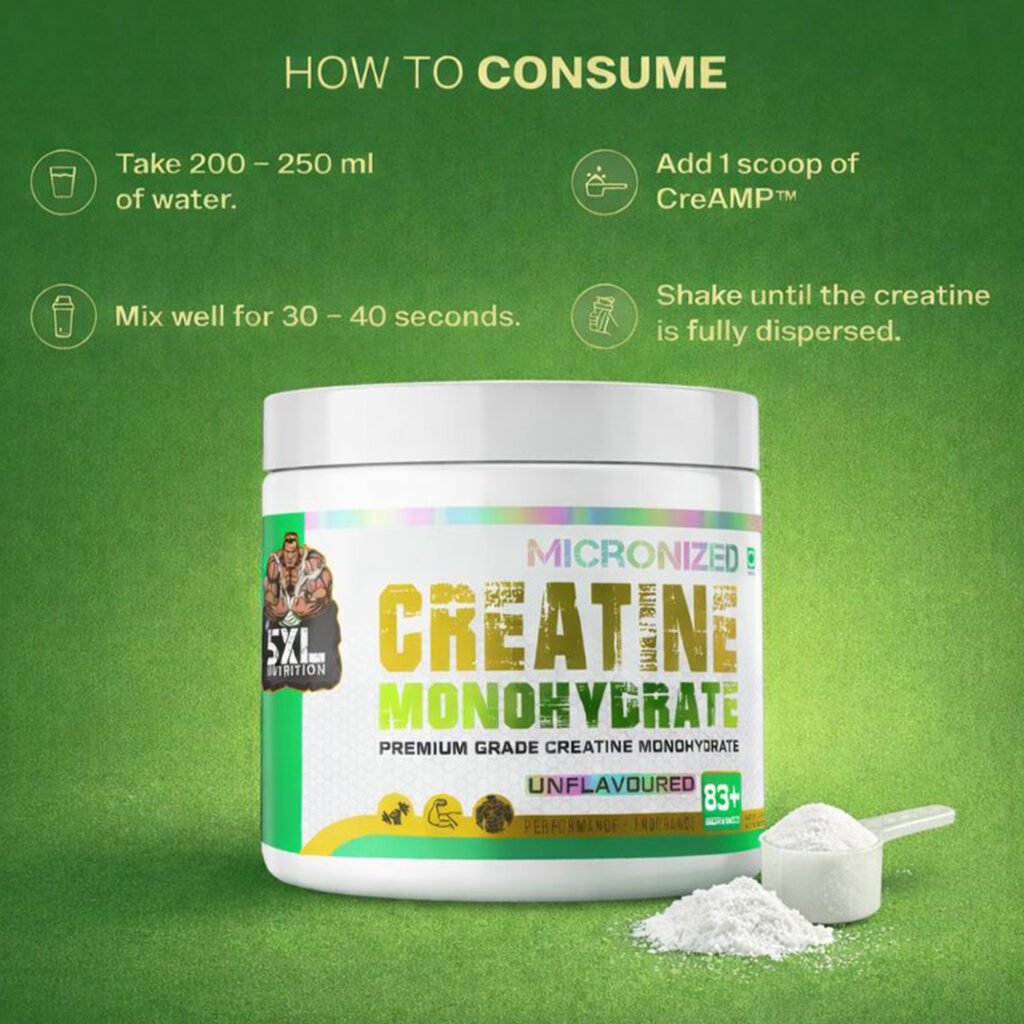
5XL Creatine Monohydrate is micronised, high-purity creatine monohydrate – no fillers, no proprietary blends, no undisclosed additives. Just creatine at the dose that clinical research has validated across hundreds of trials.
For vegetarian Indian athletes specifically, 5XL Creatine delivers:
The complete dietary creatine replacement: The 3-5g daily dose replaces and exceeds what a daily meat-eater obtains from food – bringing vegetarian muscle creatine stores from their chronically depleted baseline to full saturation and the associated performance benefits.
Transparent dosing: Every serving provides a precise creatine dose with no hidden creatine-adjacent ingredients (which can make it impossible to know actual creatine content in blended pre-workouts or “creatine complex” products).
Stackability: Creatine monohydrate is complementary to every other supplement in the 5XL range. It stacks with protein isolate (post-workout together), pre-workout (take creatine post-workout rather than with stimulant pre-workout to avoid the creatine-caffeine interaction discussed below), ZMA, and multivitamin without adverse interactions.
Shop 5XL Creatine Monohydrate Use code GOF35 for 35% off
Common Mistakes Indian Athletes Make with Creatine
Mistake 1:
Buying creatine in a proprietary blend pre-workout and assuming the dose is sufficient Many Indian pre-workouts include “creatine monohydrate” in their formula – but at doses of 500mg-1,500mg per serving, well below the 3-5g therapeutic dose. Taking pre-workout and believing creatine needs are covered is a near-universal underdosing error.
Mistake 2:
Taking creatine with caffeine and wondering why it doesn’t work One of the more nuanced areas in creatine research: a study by Vandenberghe et al. found that co-ingesting caffeine with creatine impaired the ergogenic effect of creatine on muscle relaxation time and PCr resynthesis rate. The mechanism is not fully established but is reproducible. Practical guidance: take creatine post-workout (after the caffeine from pre-workout has been consumed) rather than mixed with a caffeine-containing product.
Mistake 3:
Inconsistent daily dosing Muscle creatine stores are maintained through daily supplementation. Missing 3-4 doses per week reduces average intramuscular creatine below saturation and progressively undermines the performance benefits. Set a daily reminder. The maintenance dose is small (3-5g) and cost-negligible – consistency is the entire strategy.
Mistake 4:
Stopping creatine before a physique event due to water retention fears The water retention from creatine is intramuscular – inside the muscle cell – not subcutaneous. It does not cause the flat, “watery” look associated with glycogen loading or sodium-driven subcutaneous retention. Athletes who stop creatine before a physique event lose the intramuscular water that makes muscles appear fuller and more dense – the opposite of what they intended. Unless specifically instructed by a coach, dropping creatine pre-event is counterproductive.
Mistake 5:
Expecting creatine to work without training Creatine enhances the training stimulus – it does not independently build muscle. An athlete supplementing creatine while training less intensely due to schedule or motivation will not see the strength and hypertrophy benefits. Creatine amplifies the anabolic signal of high-effort training; it is not a substitute for it.
Creatine Monohydrate: Quick Reference for Indian Athletes
| Variable | Recommendation |
| Form | Creatine monohydrate (micronised) |
| Loading dose | 20g/day × 5-7 days (4 × 5g doses) |
| Maintenance dose | 3-5g/day |
| Timing (training days) | Post-workout with carbohydrates |
| Timing (rest days) | Any meal, any time |
| Cycle required? | No – continuous year-round use is safe and effective |
| Take with caffeine? | Avoid – separate creatine from caffeine by 2+ hours |
| Hydration increase | +500-750ml during loading; +250ml during maintenance |
| Expected strength increase | 5-15% over 8-12 weeks |
| Expected lean mass gain | 1-2kg in first 4 weeks (includes intramuscular water); ongoing lean gains from enhanced training |
| Vegetarian response vs. omnivore | Larger – due to lower baseline muscle creatine stores |
| Best combined with | Protein isolate (post-workout), carbohydrates (insulin co-transport) |
FAQ
Q: Is creatine vegetarian and vegan?
Yes. Commercial creatine monohydrate is synthesised from sarcosine and cyanamide – both chemically synthesised compounds with no animal-derived inputs. It is fully vegetarian and vegan. The creatine in supplements is not extracted from meat; it is laboratory-synthesised and has no animal origin.
Q: Will creatine cause hair loss?
This concern originates from a single 2009 study in South African rugby players that found creatine supplementation increased DHT (dihydrotestosterone) levels – and DHT is associated with androgenic alopecia (male pattern baldness) in genetically predisposed individuals. Notably, the study did not measure hair loss directly and has not been replicated. Current consensus: creatine does not cause hair loss in individuals without genetic androgenic alopecia predisposition. For those with a strong family history of early male pattern baldness, the theoretical risk is worth noting – though the evidence remains inconclusive.
Q: I’ve heard creatine damages the kidneys. Is this true?
This concern arose from early case reports in individuals with pre-existing kidney disease and has been comprehensively addressed in subsequent research. In individuals with healthy kidney function, long-term creatine supplementation at 3-5g/day does not impair renal function by any measured marker (GFR, serum creatinine, urinary markers). The only context where creatine supplementation requires caution is in individuals with diagnosed kidney disease or single-kidney status – in which case physician consultation is appropriate.
Q: How quickly will I see results as a vegetarian Indian athlete?
Strength improvements from the PCr expansion mechanism begin during the loading week itself – within 5-7 days of beginning a loading protocol, measurable improvements in rep volume and training load are typical. Lean mass changes (from the combination of intramuscular water, satellite cell activation, and enhanced training) are visible at 3-4 weeks. Significant strength and body composition changes are well-established by 8-12 weeks of consistent supplementation and training.
Q: Should I take creatine during the cutting phase?
Yes – and this is frequently underappreciated. Creatine’s muscle protein synthesis support and satellite cell activation are particularly valuable during caloric restriction, where muscle preservation becomes a primary concern. Creatine does not prevent fat loss; it helps prevent the muscle loss that often accompanies it. Continuing creatine through a cutting phase is standard practice in evidence-informed sports nutrition.
Q: Can I take creatine with my protein shake?
Yes – creatine is stable in water and protein shakes and does not chemically interact with whey protein at normal mixing temperatures. Adding creatine to your post-workout protein shake is convenient and effective. If the shake contains carbohydrates, the associated insulin response further enhances creatine transport into muscle.
Q: Is there a difference between creatine monohydrate from different brands in India?
Purity matters, and purity varies between manufacturers. The benchmark for premium creatine is Creapure (manufactured in Germany by AlzChem). Products made with Creapure or independently verified to equivalent purity standards (>99.9% creatine monohydrate, <0.1% creatinine) are meaningfully superior to low-cost Chinese creatine sourced without quality documentation. When in doubt, ask the brand for a certificate of analysis (CoA) before purchasing.
The Bottom Line
Creatine monohydrate is, by a significant margin, the most evidence-supported performance supplement in sports nutrition. Over 1,000 peer-reviewed studies and three decades of research across every strength and power sport produce a consistent, replicated finding: creatine increases phosphocreatine stores, improves performance on high-intensity efforts, and enhances muscle hypertrophy outcomes alongside resistance training.
For vegetarian Indian athletes – who begin supplementation from a position of near-zero dietary creatine intake and 20-40% depleted baseline muscle stores – the response is not just equivalent to the research average. It is better.
The protocol is simple:
- Load at 20g/day for 5-7 days (4 × 5g with meals), or start at 3-5g/day if preferring gradual saturation
- Maintain at 3-5g/day post-workout with carbohydrates on training days, any time on rest days
- Hydrate adequately – particularly during Indian summer conditions
- Supplement consistently, year-round – no cycling required
- Use micronised, high-purity monohydrate – not proprietary variants at a 3x price premium
The rest is consistency and training quality. Creatine gives you more productive sets per session. What you do with those sets determines the outcome.
Shop 5XL Creatine Monohydrate Use code GOF35 at checkout for 35% off