EAA vs BCAA: Which Is Better for Indian Athletes Who Train Fasted or Vegetarian?
The Question Every Indian Gym-Goer Eventually Asks
Walk into any supplement store in India and the BCAA shelf is impossible to miss. Dozens of flavours, multiple brands, years of gym-culture endorsement.
Then someone tells you EAAs are better and suddenly you’re spending ₹600 per tub wondering if you’ve been doing it wrong for two years.
The honest answer: it depends on your diet, your training timing, and whether you’re vegetarian. For many Indian athletes and particularly for vegetarians and those who train fasted – EAAs are not just marginally better. They are the right supplement and BCAAs are the wrong one.
For some athletes – those eating 150g+ of complete protein daily from diverse sources and training at moderate intensity BCAAs remain a defensible choice.
This article gives you the science to make that decision correctly for your specific situation, without the marketing noise that has blurred this debate in Indian fitness content for years.
What BCAAs and EAAs Actually Are: The Foundational Difference
The Amino Acid Hierarchy
The human body requires 20 amino acids to build proteins. Of these:
- 11 are non-essential – the body synthesises them from other compounds; no dietary intake required
- 9 are essential (EAAs) – the body cannot synthesise them; they must come from food or supplementation
The 9 EAAs are: leucine, isoleucine, valine, lysine, methionine, phenylalanine, threonine, tryptophan, and histidine.
BCAAs are a subset of EAAs – specifically, three of the nine: leucine, isoleucine, and valine. These three happen to have a branched molecular structure (hence “branched-chain”) and share a common metabolic pathway in skeletal muscle rather than the liver.
This means:
- Every BCAA is an EAA
- Not every EAA is a BCAA
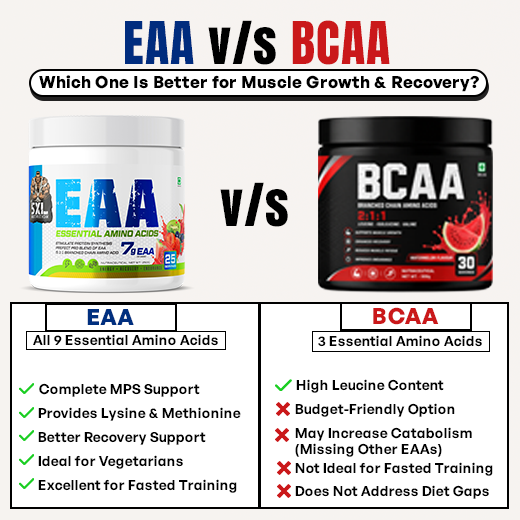
- A BCAA supplement provides 3 of the 9 essential amino acids
- An EAA supplement provides all 9
The question of which is better is therefore a question of whether the 3 BCAAs alone are sufficient to achieve what you are supplementing amino acids for – or whether you need all 9.
The Muscle Protein Synthesis Argument: Why EAAs Win on Science
This is the core scientific debate, and the research has moved decisively in one direction over the past decade.
Muscle Protein Synthesis Requires All 9 EAAs
Muscle protein synthesis (MPS) – the process of building new muscle protein from amino acid precursors is not driven by any single amino acid. It is an anabolic cascade that requires all 9 essential amino acids to be simultaneously available in sufficient quantities. The process works like a 9-ingredient recipe: missing even one ingredient stops production.
Leucine’s role is commonly misunderstood. Leucine is the primary trigger for MPS – it activates mTORC1, the upstream signalling hub that initiates the synthesis process. This is why leucine has dominated BCAA marketing for a decade. But triggering synthesis is not the same as completing it. Once mTORC1 is activated by leucine, the body requires all 9 EAAs to build the actual protein chains that constitute the anabolic response.
A helpful analogy: leucine is the ignition key that starts the engine. The other 8 EAAs are the fuel that keeps it running. BCAAs give you the key without enough fuel to go anywhere.
The Definitive Research
A landmark study by Wolfe (2017) published in the Journal of the International Society of Sports Nutrition concluded directly: “BCAAs alone are not sufficient to support maximum rates of muscle protein synthesis.” The paper showed that while BCAAs can trigger MPS initiation, the anabolic response plateaus without the remaining EAAs – and may actually accelerate protein breakdown of existing muscle tissue to source the missing EAAs from within the body.
This is a critical and underappreciated point: supplementing BCAAs without the other 6 EAAs may drive catabolism of existing muscle to source the missing amino acids. If lysine and methionine are absent from the bloodstream when MPS is triggered, the body sources them by breaking down protein – potentially including muscle tissue. The BCAA supplement that was supposed to prevent catabolism may, in certain conditions, be causing it.
A 2021 meta-analysis in Nutrients confirmed: complete EAA supplementation produces significantly greater MPS rates than BCAA supplementation at equivalent leucine doses. The incremental value of the 6 non-BCAA EAAs is not theoretical – it is measured in grams of new muscle protein synthesised per unit of amino acid consumed.
Why This Matters More for Indian Athletes Than Any Other Population
The BCAA-vs-EAA debate has a different answer in India than it does in a country where athletes eat beef, salmon, and chicken at every meal.
The Lysine Deficit in Indian Staple Foods
Lysine is the most limiting EAA in the Indian diet. It is:
- Absent in meaningful quantities from wheat – the basis of roti, the most consumed food in North and Central India
- Limited in rice – the foundation of South and East Indian dietary patterns
- Low in most cereal grains
Because wheat and rice form the caloric backbone of the Indian vegetarian diet, and because both are lysine-poor, the majority of Indian vegetarian athletes are running a chronic lysine insufficiency at the exact meals they rely on for protein.
BCAAs contain zero lysine. A vegetarian Indian athlete taking BCAAs intra-workout, eating roti and dal as their major protein source, and wondering why muscle gain is slower than expected is experiencing the lysine bottleneck – without knowing it.
EAAs contain lysine. A single 7-10g EAA serving provides approximately 600-900mg of lysine – directly supplementing the EAA that the Indian vegetarian diet most consistently under-delivers.
The Methionine Deficit in Legume-Heavy Diets
Methionine is the initiator amino acid in protein synthesis – every protein chain in the body begins with methionine. It is also the most limiting EAA in legumes: dal, rajma, chana, and moong are all methionine-limited.
Indian vegetarian athletes relying on legumes as their primary protein source are methionine-insufficient at the cell level – meaning protein synthesis is limited not by total amino acid availability, but by the availability of the specific amino acid that starts the process.
BCAAs contain zero methionine. The problem remains unaddressed.
EAAs contain methionine. Each serving delivers the initiator amino acid that plant-protein-heavy diets consistently under-provide.
The Incomplete Protein Reality
The Indian fitness community commonly argues that combining foods achieves complete protein – dal + roti, for instance, provides complementary amino acids when assessed over a full day.
This is nutritionally true at the population level. It misses the timing reality relevant to athletes.
Muscle protein synthesis requires all 9 EAAs to be simultaneously available in the bloodstream at the time of anabolic triggering – during and immediately after training. It is not sufficient for methionine to arrive from lunch while lysine arrives from dinner and leucine from the post-workout shake. The synthesis window does not hold open for hours waiting for the full amino acid set to assemble.
EAA supplementation intra-workout delivers all 9 EAAs simultaneously into the bloodstream during the precise window when muscle protein synthesis capacity is highest. Food-based amino acid timing, regardless of dietary completeness across the day, cannot replicate this synchronisation.
Fasted Training: Why EAAs Are the Only Sensible Choice
A significant proportion of Indian athletes – particularly morning trainers exercise in a fasted or semi-fasted state. The reasons vary: early gym times before breakfast, religious fasting practices, intermittent fasting protocols, or simply a preference for training before eating.
Fasted training creates the highest catabolism risk scenario in any training programme. Without circulating amino acids from recent food intake, the body has two sources for the amino acids muscle cells need during exercise: the bloodstream pool from ongoing protein turnover, and – when that pool is insufficient – muscle tissue itself.
What Happens to Muscle During Fasted Training
High-intensity resistance training during a fasted state activates both muscle protein synthesis (anabolic signal from mechanical tension) and muscle protein breakdown (catabolic signal from the absence of dietary amino acids and the metabolic demands of exercise). The net outcome – gain or loss of muscle protein – depends on the amino acid availability in the bloodstream during and after the session.
Without amino acid supplementation, fasted training consistently produces a net negative protein balance – more protein broken down than synthesised. The muscle damage from training is real; the repair materials are absent.
Why BCAAs Alone Are Insufficient for Fasted Training
Taking BCAAs before fasted training addresses the leucine-mediated anabolic trigger and partially reduces catabolism. But the 6 missing EAAs mean that even if MPS is initiated, it cannot be completed. The result is a partial anabolic response – better than nothing, significantly worse than a complete EAA supplement.
Additionally, during fasted training, the body’s demand for gluconeogenic amino acids (amino acids used for energy when glucose is depleted) includes several of the non-BCAA EAAs. The body will source these from muscle if they are not provided exogenously – and BCAAs do not provide them.
EAAs Before Fasted Training: The Correct Protocol
Taking 7-10g EAAs 10-15 minutes before fasted training provides:
- The leucine anabolic trigger (present in EAAs)
- The complete amino acid set required for MPS completion (all 9 EAAs)
- Gluconeogenic substrate to spare muscle from being broken down for energy
- A minimal caloric load that does not meaningfully break the fast for most intermittent fasting protocols (pure EAAs provide approximately 28-40 calories per 7-10g serving)
This is the reason sports scientists and coaches with a fasted training clientele almost universally recommend EAAs over BCAAs in this context. The BCAA option is half a solution at best.
EAA vs BCAA: Side-by-Side Comparison
| Factor | EAA Supplement | BCAA Supplement |
| Amino acids provided | All 9 essential amino acids | 3 (leucine, isoleucine, valine) |
| Muscle protein synthesis | Complete – all substrate available | Partial – triggers but cannot complete |
| Lysine provision | Yes | No |
| Methionine provision | Yes | No |
| Catabolism prevention | Complete anti-catabolic profile | Partial – may increase catabolism by sourcing missing EAAs from muscle |
| Fasted training suitability | Optimal choice | Suboptimal |
| Vegetarian Indian diet suitability | Addresses diet-specific EAA gaps | Does not address lysine/methionine gaps |
| Price per serving (typical India) | ₹45-65 | ₹25-45 |
| Evidence base for MPS | Strong – multiple RCTs | Weaker – MPS benefits incomplete without other EAAs |
| Typical leucine content | 2-3g per 7g serving | 5-7g per 10g serving |
| Best for | Vegetarians, fasted training, incomplete diets, optimising MPS | Athletes with complete high-protein diets, cost-sensitive supplementation |
The Price Argument for BCAAs – And Whether It Holds
The most legitimate argument for BCAAs over EAAs is cost. A quality BCAA supplement in India typically runs ₹25-45 per serving versus ₹45-65 for EAAs. For an athlete supplementing daily, that difference over a month is ₹600-₹1,200 – meaningful for many Indian athletes.
This cost argument is valid only if the athlete has confirmed protein sufficiency from complete sources throughout the day – specifically covering lysine and methionine. For athletes eating red meat, chicken, eggs, and dairy multiple times daily at quantities meeting 1.6-2.2g protein per kg bodyweight, the marginal benefit of EAAs over BCAAs narrows significantly. The amino acids absent from BCAAs are already circulating from dietary protein.
For most Indian vegetarian athletes, that condition is not reliably met – making the BCAA cost saving a false economy. Paying ₹30 less per serving for a supplement that doesn’t address your actual amino acid gap produces no saving in terms of performance outcome.
The relevant cost comparison for vegetarian Indian athletes is not “EAA vs BCAA.” It is “EAA vs the dietary restructuring required to ensure complete amino acid provision at every training-adjacent meal” – which is both more expensive and less reliable than a ₹50 EAA serving.
When BCAAs Are Still a Reasonable Choice
This article has made the case for EAAs decisively for specific populations. There are genuine scenarios where BCAAs remain a reasonable choice:
Omnivores eating 180-200g complete protein daily: Athletes eating chicken, eggs, fish, and dairy at multiple daily meals likely already have adequate circulating levels of the non-BCAA EAAs. In this context, BCAAs serve as a cost-efficient leucine delivery mechanism for intra-workout anabolic signalling without the need to pay for EAAs the diet is already providing.
Athletes using BCAAs to complement a whey protein regime: Post-workout whey protein already delivers all 9 EAAs. BCAAs taken intra-workout, combined with post-workout whey, provides acceptable amino acid completeness across the training window. The BCAAs cover intra-workout catabolism prevention; the whey covers MPS completion post-workout.
Budget-constrained recreational athletes at lower training volumes: For someone training 3x per week at moderate intensity with a mixed diet, the incremental performance benefit of EAAs over BCAAs is smaller and the cost saving more meaningful. This is a legitimate trade-off.
Athletes in weight-cut phases who want maximum leucine per calorie: BCAAs provide a higher leucine-to-calorie ratio than EAAs, which may matter for athletes in extreme caloric restriction managing every gram of caloric intake.
Outside these specific scenarios – and particularly for vegetarian Indian athletes training at meaningful intensity – EAAs are the evidence-correct choice.
Decision Framework: EAA or BCAA for Indian Athletes?
Answer these three questions:
1. Is your diet primarily vegetarian or predominantly plant-based? → If yes: choose EAAs. The lysine and methionine gaps in your diet are real and BCAAs do not address them.
2. Do you regularly train fasted or semi-fasted (morning training before breakfast)? → If yes: choose EAAs. The complete anti-catabolic and MPS-completion profile is necessary in the absence of circulating dietary amino acids.
3. Are you consistently hitting 1.8-2.2g protein per kg bodyweight from diverse complete protein sources at every major meal? → If yes: BCAAs remain a defensible intra-workout option. The EAA advantage narrows when dietary completeness is reliably achieved.
If your answer to questions 1 or 2 is yes, choose EAAs. If your answer to question 3 is yes and 1 and 2 are no, BCAAs are a cost-effective alternative.
Most Indian vegetarian athletes answer yes to question 1. Most Indian morning trainers answer yes to question 2. The majority of the Indian athletic population should be using EAAs.
The 5XL Nutrition EAA: The Right EAA for Indian Athletes
5XL Nutrition EAA delivers 7g of all 9 essential amino acids per serving – including the lysine and methionine that vegetarian Indian diets consistently under-provide. It includes an integrated electrolyte matrix (sodium, potassium, magnesium) that supports amino acid transport and hydration during Indian summer training conditions.
Full ingredient disclosure – every amino acid listed with its individual dose, not hidden in a proprietary blend. Zero added sugar. Vegan certified. FSSAI approved. And the only EAA in the Indian market with batch-level product authentication at the5xlnutrition.com/verify-product.
At ₹45-55 per serving, it is the most cost-efficient complete EAA supplement in India with full label transparency – eliminating the price objection that pushes many Indian athletes toward BCAAs without the nutritional trade-off.
Recommended protocol:
- Fasted morning training: 1 serving in 400-500ml water, 10-15 minutes before session begins
- Intra-workout: 1 serving sipped throughout the session (the primary recommended timing)
- Post-workout without immediate whey: 1 serving immediately post-session with carbohydrates
Shop The 5XL Nutrition EAA Use code GOF35 for 35% off On MRP
FAQ
Q: Can I mix EAAs and BCAAs together?
There is no adverse interaction between EAAs and BCAAs – you are simply increasing amino acid intake. However, it is redundant. EAAs already contain the 3 BCAAs plus the 6 additional EAAs. Taking BCAAs on top of EAAs adds leucine, isoleucine, and valine again – which does not meaningfully further MPS beyond what the EAA serving already provides. Save the cost: use EAAs alone.
Q: Do EAAs break a fast?
Pure EAA supplements provide approximately 28-40 calories per serving – primarily from the amino acids themselves. For most intermittent fasting protocols (16:8, 18:6), this caloric load does not meaningfully activate the metabolic responses associated with breaking a fast – particularly insulin response, which is minimal for amino acids without accompanying carbohydrates. EAAs before fasted training are widely used by intermittent fasting athletes without compromising their fasting outcomes. Athletes following strict fasts (religious fasts, extended medical fasts) should assess their specific protocol’s guidelines.
Q: I’ve been taking BCAAs for 2 years. Was it a waste?
Not entirely – the leucine, isoleucine, and valine you were consuming have genuine anti-catabolic and anabolic triggering effects. You were not harming yourself. The accurate framing is: you were using a partial solution when a complete solution was available. The incremental gain from switching to EAAs particularly if you are vegetarian or training fasted – is meaningful and will compound over the months and years ahead.
Q: My trainer says BCAAs are enough if I eat enough protein. Is he right?
Conditionally yes. If “enough protein” means 1.8-2.2g per kg from diverse complete animal sources consumed regularly, including in the training-adjacent period, the incremental advantage of EAAs over BCAAs is modest. The trainer’s advice is sensible for omnivores with disciplined complete protein intake. For vegetarian athletes or those with inconsistent complete protein timing, it is incorrect – and many Indian trainers have not updated their recommendation since the BCAA-dominance era of the 2000s and 2010s.
Q: Is there an EAA supplement for vegetarians in India that is good quality?
Yes – 5XL Nutrition EAA is vegan certified, fully plant-compatible, and addresses the specific EAA gaps (lysine, methionine) most significant in Indian vegetarian diets. It is one of very few Indian EAA products with both full label disclosure and confirmed vegan certification. See the full EAA comparison article for the six-brand breakdown.
Q: What is the leucine content of EAA supplements vs BCAA supplements?
BCAA supplements typically provide 5-7g of leucine per 10g serving (because leucine is 50% of the BCAA ratio). EAA supplements provide approximately 2-3g of leucine per 7-10g serving (because leucine is one of 9 EAAs). If maximising leucine per serving is your only goal, BCAAs deliver more. However, research shows that leucine’s anabolic triggering effect is maximised at approximately 2-3g beyond which additional leucine provides no further MPS stimulus. The 2-3g leucine in a quality EAA supplement is sufficient to trigger MPS, and the remaining 6 EAAs provide the substrate to complete it. Higher leucine from BCAAs without the other EAAs produces the same incomplete result.
The Bottom Line
BCAAs are not a bad supplement. They are an incomplete one – for a specific and large subset of the Indian athletic population.
If you are vegetarian, your diet has specific lysine and methionine gaps that BCAAs do not address. If you train fasted, your intra-workout catabolism requires a complete anti-catabolic amino acid profile that BCAAs cannot provide. If your protein sources are not consistently complete and timed around training, EAAs are the correct tool.
Science resolved this debate some time ago. EAAs produce greater MPS than BCAAs at equivalent leucine doses. EAAs prevent catabolism more completely. EAAs address the specific amino acid gaps in Indian vegetarian diets.
The reason BCAAs still dominate Indian supplement shelves is not scientific evidence – it is legacy marketing from an era when the amino acid research was less developed and the Indian supplement market was less sophisticated.
That era is over. Make the switch informed.
Shop The 5XL Nutrition EAA Use code GOF35 at checkout for 35% off